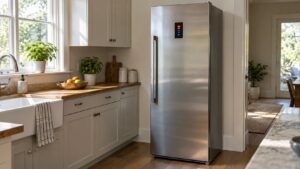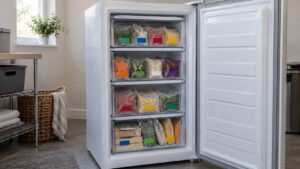
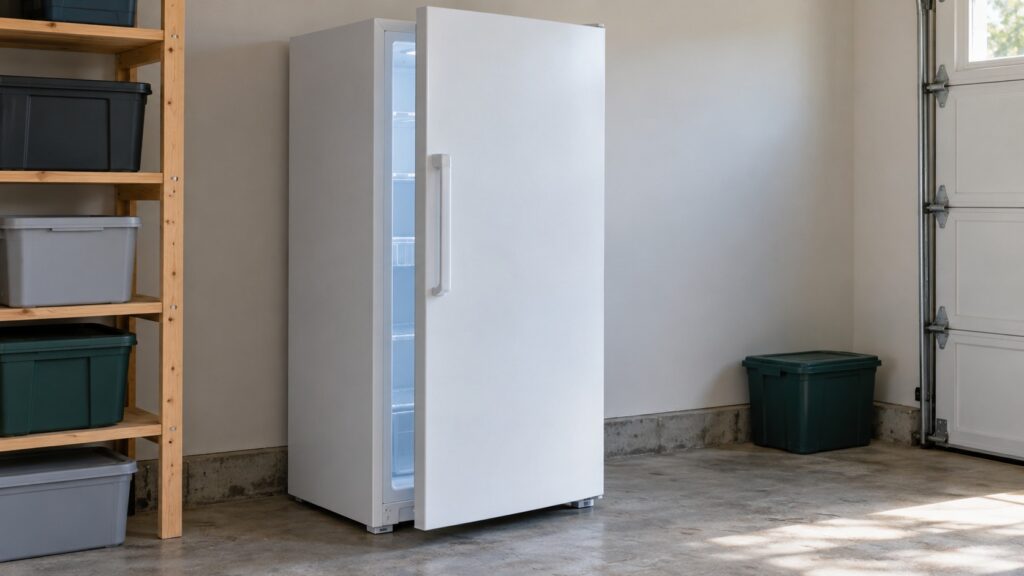
The LG freezer repair or replace question has a short answer for an upright model: repair is usually the right call when the fault is a sensor, a fan, the defrost circuit or a setting, and replacement deserves a serious look when the code points to a refrigerant leak in the sealed system. The upright models on this site, the 11.4 cu ft LROFC1104V column and the 6.0 cu ft LROFC0605V, are frost-free freezers with automatic defrost and Multi-Air Flow cooling, and their codes name one part each, so the display often tells you which side of the line you are on before anyone opens the cabinet.
When is it worth repairing an LG upright freezer?
When the fault is a single part on an otherwise sound freezer. The site’s code pages describe the usual ones: a failed temperature sensor (FS), a failed defrost sensor (dS), a condenser fan that is not running (CF) and an evaporator fan that is not circulating air (FF). Each is a small part with a clear job, and replacing it restores the freezer without touching the sealed system. A defrost fault (dH) is also commonly worth chasing, because the cause is usually a part in the defrost circuit, not the freezer as a whole. Our guide to LG upright freezer error codes explains each of these in turn. In general, a part swap is usually far cheaper than a new unit, and a freezer that is otherwise clean and cold should be kept.
When should you check for a setting before you call anyone?
Always, because two of the eight codes need nothing more than a button press. OFF means demo mode, which keeps the display running but turns cooling off. Exiting it is a setting change described in your owner’s manual, not a repair. Sb means Sabbath mode, which is also a setting. Both are listed on the freezer model pages as not a problem. Before you decide anything about repair or replacement, read the exact letters on the display and rule these out. Our page on a freezer that is not freezing walks through this check, along with the setpoint and the door seal.
What does a refrigerant leak code mean for the decision?
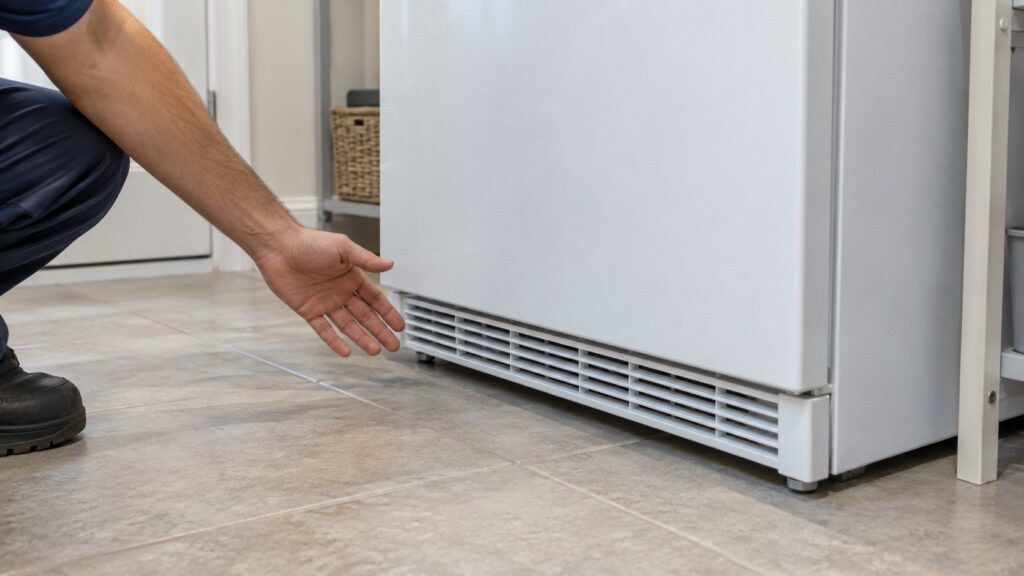
The one code that changes the arithmetic is CL E. The site describes it as a low-side refrigerant leak in the sealed system and calls it a serious problem, and its page is at LG freezer CL E. A sealed-system repair is not a parts-swap job: the refrigerant circuit has to be found, repaired and recharged by a technician with the right equipment, and the work is a large part of the freezer’s value on an older unit. That is where replacement starts to look reasonable. If the freezer is young, a technician’s quote is worth getting before you decide. If it is old and also has other problems, the quote may point to a new unit. Note the code exactly, because on a freezer CL means the refrigerant code, not a lock, as it does on some other appliances.
How do age and condition change the answer?
Age matters mostly when the repair is large. A sensor or fan on a freezer of any age is a fair repair, because the rest of the unit is unaffected. A sealed-system fault on an old freezer is the classic replace case. Ask the technician for a written quote and weigh it against the freezer’s age and condition; this site gives no price threshold. Frequent repeat faults across different systems are another sign that the freezer is wearing out. Also weigh what the freezer holds. A freezer in the garage that is opened often and runs warm has a harder life than one in a cool pantry, and the repair history tells you more than the model number does.
What should you do with the food while you decide?
Keep the door closed. By FDA guidance, a full freezer will hold its temperature for about 48 hours if the door stays shut, and a half-full freezer for about 24 hours. If the freezer has failed, move food to a working freezer or to coolers with ice before that window ends. Food that still has ice crystals or is at 40°F or below can usually be refrozen or cooked, and anything that has been warmer than 40°F for two hours or more should be thrown away. When in doubt, throw it out. If you smell burning, see smoke or water around the cabinet, switch the freezer off at the breaker with dry hands and leave the cabinet closed for a technician. Never open the back panel or the compressor area yourself.
Where does a freezer fit among LG’s other repair-or-replace guides?
LG refrigerators and freezers share their code family and many parts, so the reasoning in our repair or replace an LG refrigerator guide applies here too: fans, sensors and defrost parts are routine repairs, and a sealed-system fault on an older unit is the classic replacement trigger. A frost problem alone does not mean replace; our page on an LG freezer building up frost shows the checks that come first. If you want a hand reading the display, our LG freezer repair page explains how a visit works, and you can compare specs for your model, for example LROFC1104V.