An LG frost-free refrigerator does not defrost by itself in the way people imagine. Every few hours of compressor running time, the control switches the cooling off, warms the evaporator coil with a heater until the frost melts, drains the water to a pan and then restarts cooling. Knowing that sequence tells you which part to suspect when frost builds up, water pools or an Er dH or Er dS code appears.
Open the freezer of an old chest freezer and you find a thick coat of ice. Open an LG refrigerator and you find none, even after years. That is not magic: the machine melts its own frost on a schedule. This guide explains how LG refrigerator defrost works, step by step, so you can read what the symptoms are telling you. It also draws a clear line between what an owner can safely check and what belongs to a technician.
How does an LG refrigerator defrost itself?
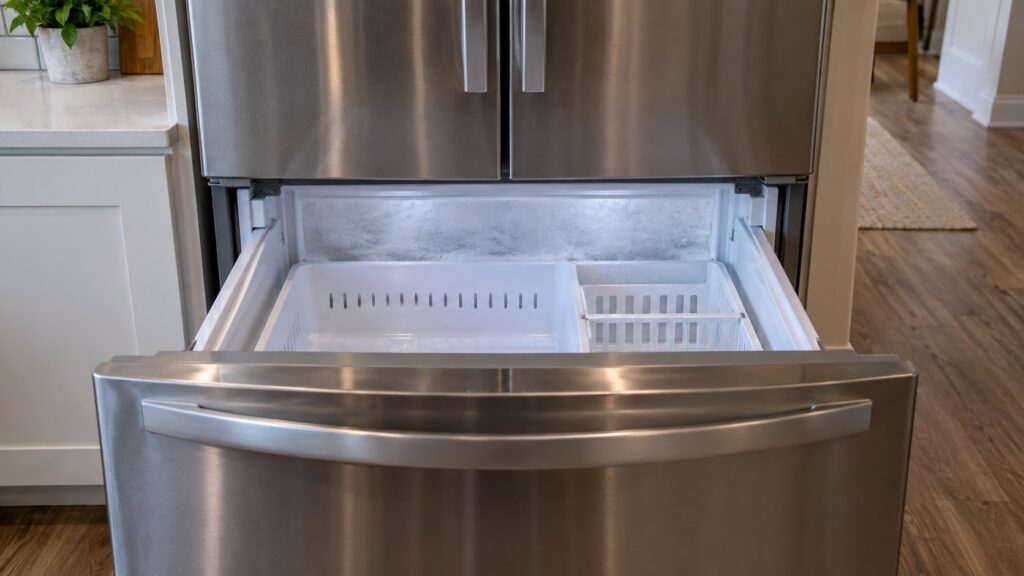
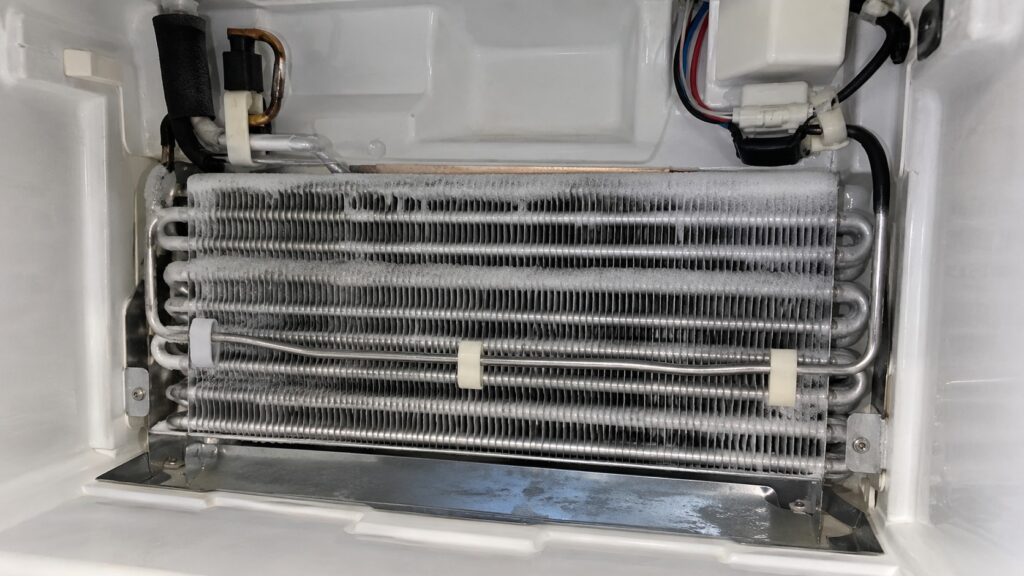
Cold air is made at the evaporator, a finned coil hidden behind a panel at the back of the freezer. Moisture in the air freezes onto those fins as the coil runs, so over time a layer of frost forms. If it were left alone, the layer would choke the airflow and cooling would fall off. To prevent that, the control board runs a defrost cycle: it stops the compressor and fans, powers a heater that sits against the coil and waits until a sensor says the coil is above freezing. Then it ends the cycle and cooling resumes.
Most modern LG models decide when to defrost by counting compressor running time and door openings, not by the clock alone. A fridge that is opened often in humid weather defrosts more often than one in a quiet kitchen. The cycle usually lasts well under an hour, and you will rarely notice it other than a faint crackling or dripping sound.
What happens to the water when the frost melts?
The meltwater drips off the coil into a trough, runs down a drain tube and collects in a shallow pan near the compressor. Warm air from the compressor evaporates it, so in a healthy refrigerator you never see the water. When something goes wrong along that route, you do. A drain tube partly blocked by food debris or ice sends water over the edge of the trough and onto the floor of the freezer, where it refreezes into a sheet of ice. A cracked pan or a pan that is out of place can put water on the floor of the kitchen.
This is why a puddle under an LG refrigerator is not always a supply-line leak. If the water appears after a defrost and the freezer floor is icy, the drain path is the first thing to examine. Our LG freezer frost buildup guide shows how to tell a drain problem from heavy door openings.
What do Er dS and Er dH tell me about the defrost system?
The LG refrigerator code pages treat these two letters as the control’s way of reporting a defrost problem. Er dS points at the defrost sensor: the reading is out of range, so the control cannot tell when to start or stop. Er dH means the cycle ran too long without finishing, which usually means the coil is not warming as it should. You can read the details on the dS page and the dH page, and our LG refrigerator Er codes guide lists the whole family side by side.
Think of the parts as a chain: board, sensor, heater, coil, drain. A break at any link produces a different symptom. A dead heater leaves the coil frosted and the airflow weak. A faulty sensor can stop a cycle from starting or ending. A blocked drain turns meltwater into ice. A failed fan, which shows as FF, leaves cold air stuck at the back even when the coil is clear.
What are the signs that defrost is failing?
The earliest sign is usually frost on the back wall of the freezer, followed by weaker airflow from the vents and a freezer that holds temperature poorly. Next, the refrigerator section warms, because most of its cold air comes from the same coil. You may also hear the compressor run for long stretches, or see ice on the freezer floor. If the display shows dS or dH, the control has already noticed. If you are seeing food warm while the compressor runs, the LG refrigerator not cooling guide helps you sort the cause.
Frost on the back panel is not always a defrost fault. A door left ajar, a bag of ice pressed against the gasket or a very humid week can cause a short-lived frost layer that the next cycle clears. If the frost returns within days after you have cleared the cause, suspect the system.
What can I safely do myself, and what should I leave alone?
Safe owner steps are simple. Check that nothing blocks the vents, that the doors close fully and that the gaskets seal. Unplug the refrigerator, empty the freezer into a cooler and let it stand open with towels on the floor for several hours to melt a heavy frost layer, then wipe it dry. After a full manual defrost, the system often runs normally for weeks, which tells you the fault is in the drain or the sensor rather than in the heater.
Do not chip ice with a knife, and do not aim a hair dryer at the back panel for long. The plastic liner and the sensor wires are easy to damage, and a cracked liner is a permanent problem. Do not remove the rear panel to test the heater: it is a part wired to household voltage, and the coil sits behind sharp fins. Leave the testing of the heater, sensor and board to a technician. The LG refrigerator repair page lists what we check, and if the unit is older and the repair is large, the LG refrigerator repair-or-replace guide helps you weigh it. When you are ready, schedule a visit.