The LG WashTower vs stacked pair question comes up in every laundry closet remodel, and the honest answer depends less on the specifications than on the room, the plumbing and how long you plan to keep the appliances. Both put a washer under a dryer in the same footprint. One is a single engineered unit with one control panel; the other is two independent machines held together by a bracket. That difference decides installation, service and what happens in ten years when one half fails.
What a tower actually changes
The obvious change is the control panel. On a stacked pair the dryer controls sit on top of the dryer, which on a tall installation can be at or above eye level — awkward for a short person and genuinely difficult from a wheelchair. A tower puts both sets of controls in one panel in the middle, at a height most people can reach without stretching.
The less obvious change is that the two halves are designed to work together: a single control brain coordinates the wash and the dry, so the dryer can be set up from the same place and the same cycle logic. That is a convenience benefit rather than a cleaning one — the laundry does not come out cleaner, it just takes fewer decisions.
What a stacked pair keeps
Independence, mostly. You choose the washer you want and the dryer you want, including a ventless heat-pump dryer if the room has no duct — a decision our guide on vented versus heat-pump dryers covers in detail. You can buy them a year apart, and if one dies you replace only that one.
That last point deserves weight. Laundry appliances rarely fail at the same time, and the ability to replace half a laundry is a real financial hedge on a ten-year horizon.
The room decides more than the brochure
That last row catches people. A stacked pair goes upstairs as two manageable boxes; a tower goes up as a single tall unit that cannot be split for the corner at the top of the stairs. Measure the route, not just the space.
Installation, honestly compared
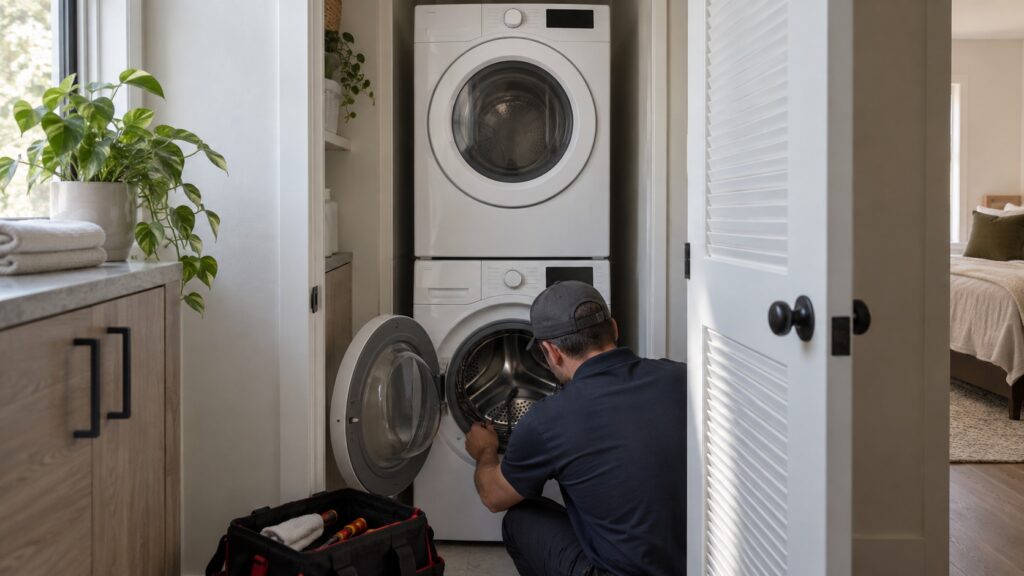
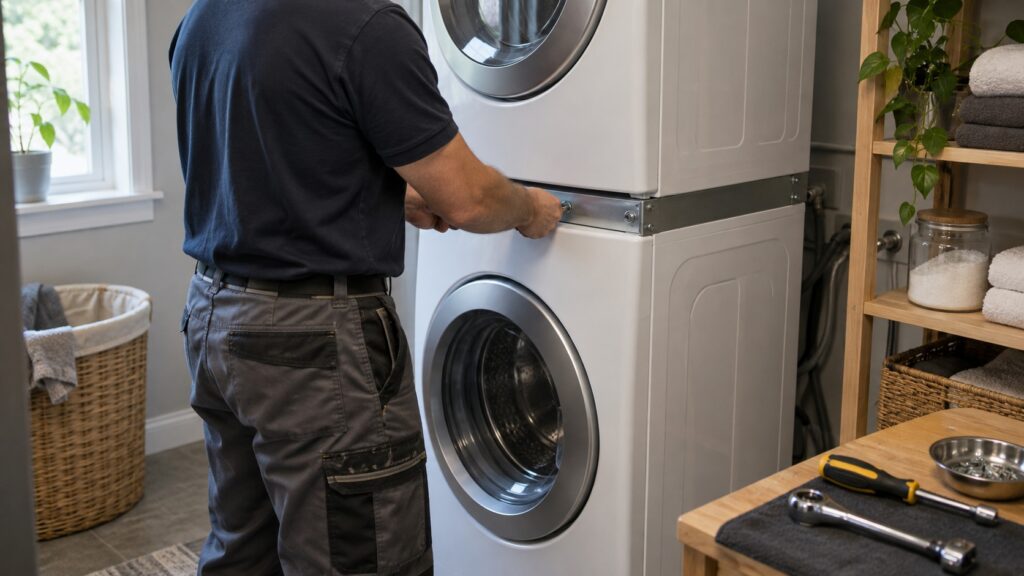
A tower is simpler at the hookup: level it, connect water, drain and power, attach the vent if it is a vented model, and you are done. A stacked pair needs the stacking kit fitted correctly, and that bracket is not optional — an unsecured dryer on top of a spinning washer is a genuine hazard.
Both share the same non-negotiables: a level floor, a secure drain, and enough space behind for hoses without kinks. Vibration problems in laundry closets are nearly always floor and leveling problems, and they get blamed on the machines. Our WashTower installation guide covers the clearances and the leveling procedure.
Capacity is the other thing to check rather than assume. A tower pairs a washer and dryer chosen to match each other, which is tidy but fixed; with separates you can put a large-capacity dryer over a smaller washer if your laundry is mostly bulky and light. Compare the cubic-foot figures for both halves side by side before deciding that two units of the same height hold the same amount.
Service and the ten-year view
Day-to-day repairs are similar on both. Pumps, valves, belts, heaters and boards are the same families of parts, and a technician reaches them in similar ways. Where the paths diverge is at replacement. A stacked pair lets an owner swap one machine while keeping the other. A tower is engineered and sold as one appliance, so a decision about a major failure is a decision about the whole unit.
That is not an argument against a tower. It is an argument for buying a tower when the ergonomics and the tidy fit genuinely matter, and buying separates when you want the flexibility. Owners who care most about capacity and machine choice usually land on separates; owners with a tight closet and a bad back usually land on a tower and are happy about it.
How to decide in five minutes
Measure the space, including the route in. Decide whether a vent exists. Then ask two questions: does anyone in the house struggle to reach a control panel above shoulder height, and would you rather replace half a laundry or all of it? If reach matters and the closet is tight, choose the tower. If you want to mix a specific washer with a specific dryer, or you value replacing one half later, choose separates and fit the stacking kit properly.
If you are still choosing the washer itself, our guide on front-load versus top-load is the other half of the decision, since only a front-load machine can sit under anything at all.
When to call
Call when a new installation walks, vibrates or trips a breaker, when a stacking kit is missing or does not match the machines, when a dryer takes far longer than it used to, or when you want the duct checked before a new dryer goes in. A laundry pair installed on an unlevel floor will eventually damage itself, and that is cheaper to prevent than to repair.
We are an independent repair company, not a factory service arm. Pricing starts from a diagnostic visit — from $89 — with the estimate confirmed before work begins. LG washer repair covers WM, WT and WashTower machines, and you can schedule a visit online.