
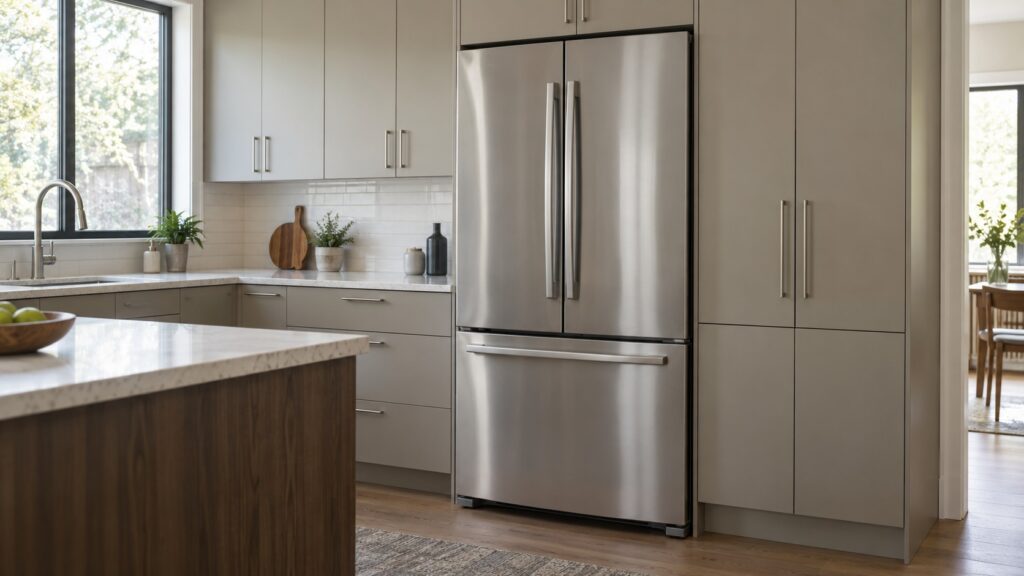
An LG counter-depth refrigerator is built to sit nearly flush with standard kitchen cabinets instead of sticking out past them, and on this site the counter-depth French-door models in the 26 cu ft class (LRFXC2606S, LRFOC2606S and LRYKC2606S) are 36 in wide. The trade is simple: you get a cleaner kitchen line and a refrigerator that does not crowd the walkway, and in return the cabinet is shallower than a standard-depth model of the same width, so you should check the capacity number before you fall for the looks.
What does counter-depth mean on an LG refrigerator?
Counter-depth describes how far the refrigerator body reaches into the room. A standard-depth refrigerator is deeper than the cabinets beside it, so the doors and handles stand out into the kitchen. A counter-depth refrigerator is made shallower so the cabinet body lines up with the countertop edge and the cabinet fronts. On the model pages of this site, LG lists the install type of these units as counter-depth free-standing, which means they are not built into the cabinetry: they stand on the floor like any other refrigerator and simply project less. The doors and handles still stand slightly proud of a flat cabinet face, because the hinges and handles add to the footprint.
We do not list the exact depth in inches for each model, because that number is on the spec sheet and the installation sheet for your exact model rather than on this site. Use those documents for your cutout, not a general rule of thumb.
Which LG counter-depth models are on this site?
Four 26 cu ft French-door models carry the counter-depth label here: LRFXC2606S and LRFOC2606S, both listed as counter-depth MAX, LRYKC2606S, listed as counter-depth, and LRYXC2606S, also counter-depth MAX but with a dual ice maker that includes Craft Ice. All are 36 in wide. The 23 cu ft URNTC2306N is a counter-depth InstaView model, and the 12 cu ft LRBCC1204S is a narrow bottom-freezer unit that is only 24 in wide. LRRXC2606S, listed as an ordinary free-standing French-door model of the same capacity and width, is the comparison point: it shows that the 26 cu ft figure is shared by the standard and counter-depth versions in this family. You can open any of them from its page, for example LRFXC2606S, to see the full specifications.
The model pages also list the same sealed-system detail for the whole group: a Linear Inverter Compressor with a 10-year listing, Door Cooling+, ThinQ with Smart Diagnosis, LED lighting and ENERGY STAR certification. If a feature matters to you, read it from your model’s page, since two refrigerators of the same width can differ in ice maker, doors and finish.
How much storage do you give up with counter-depth?
Less than most people expect on the 36 in French-door models, and the pages of this site show why. The counter-depth LRFXC2606S, LRFOC2606S and LRYKC2606S offer 26 cu ft, while the standard LRRXC2606S offers the same 26 cu ft. That is the capacity LG lists for that family, so within it you are not paying a big storage penalty for the narrower profile. Larger standard-depth models on the site list more, for instance 31 cu ft for LRYKS3106S and the InstaView URNTS3106N, so if you need the most room for a big household, a deeper cabinet still wins on raw capacity.
Where counter-depth does cost you is shelf depth in practice. Wide platters, sheet-pan pizzas and tall party trays are the first things to stop fitting. Before you commit, hold the biggest dish you regularly store against the interior measurements on the spec sheet for the model you want.
What should you measure before you buy?
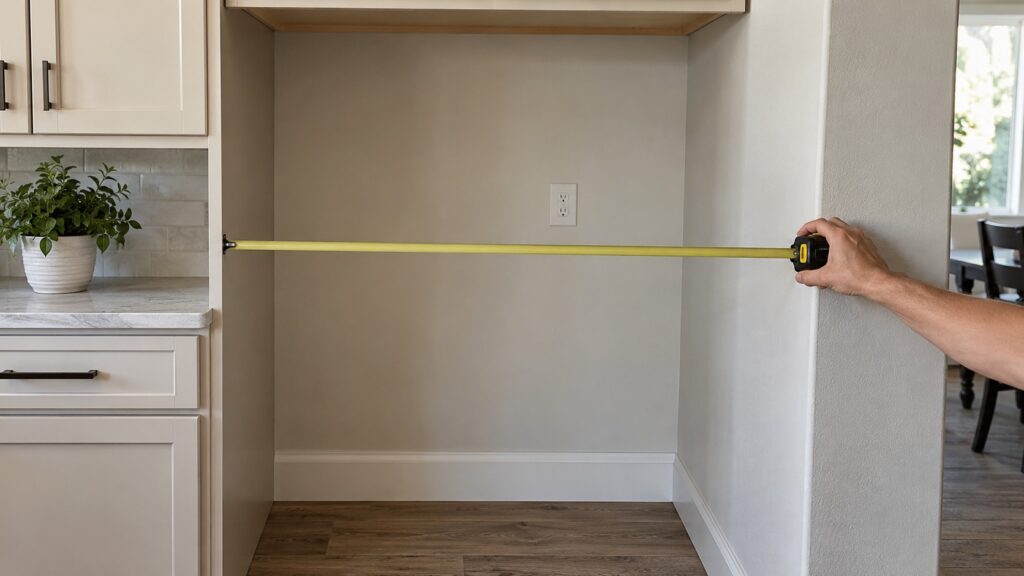
Measure the opening and the path to it, not only the space. Check the width of the opening against the 36 in cabinet width, and leave the clearance the installation sheet asks for at the sides, top and back, because a refrigerator that is pushed tight cannot shed heat or open its doors fully. Then check the route: doorways, hallways, the turn at the end of the hall and the stairs, because a 36 in refrigerator that arrives and cannot get through the door is a very expensive mistake. Finally check the door swing. French doors need less sweep room than a single wide door, but a handle that hits a wall or an island corner will stop the door short and block a drawer from sliding out.
The water line matters too. If the model makes ice or has a dispenser, the supply must reach the back of the cabinet without a kink, and a counter-depth refrigerator leaves less room behind it for a coiled hose. Our guide to setting up the LG refrigerator water line covers what to plan for.
Is counter-depth better than a standard French-door model?
It depends on what you are fixing. Counter-depth is the better choice when the kitchen is narrow, the refrigerator stands beside an island or at a wall opening, or when you want the lines of the cabinets to run unbroken. A standard-depth model is the better choice when capacity is the first goal. If you are weighing the style of the doors instead, our comparison of LG French-door and side-by-side refrigerators covers that decision, which is a separate one from depth. The InstaView models, described in the InstaView glossary entry, add a knock-to-see glass panel, but that feature does not change the depth class.
One practical point: a counter-depth refrigerator is not a built-in. If you want a surface that is truly flush with the cabinet fronts, you need a built-in model and a custom cutout, and that is a different product category from the free-standing models described here.
What should you know about service and cost over the years?
Counter-depth does not change how LG refrigerators fail. The common problems are the same as for any model of the family: ice maker faults, a clogged defrost path, a door that is not sealing or a display warning. The difference is access, because a refrigerator that sits tight in a cabinet opening is harder to pull out, and a service visit goes faster if you leave room to move it. When the day comes that a repair is quoted, a part swap is usually far cheaper than a new unit, but an older refrigerator with a sealed-system fault is a different story. Our guide to repairing or replacing an LG refrigerator sets out how to weigh it, and our LG refrigerator repair page explains what a technician visit involves.