If you are looking up how to reset LG dishwasher glitches, the answer is a power cycle: switch it off at the circuit breaker for a minute or two, switch it back on and start a fresh cycle. That clears a stuck display, a cycle that froze after a power dip and most one-off glitches, and it does not erase anything you need. A reset does not fix a real fault: if the same code comes straight back, the dishwasher is pointing at a part, and the code tells you which one. The steps for any button-based reset differ by model, so your owner’s manual has the exact key presses if a model uses them.
How do you reset an LG dishwasher?
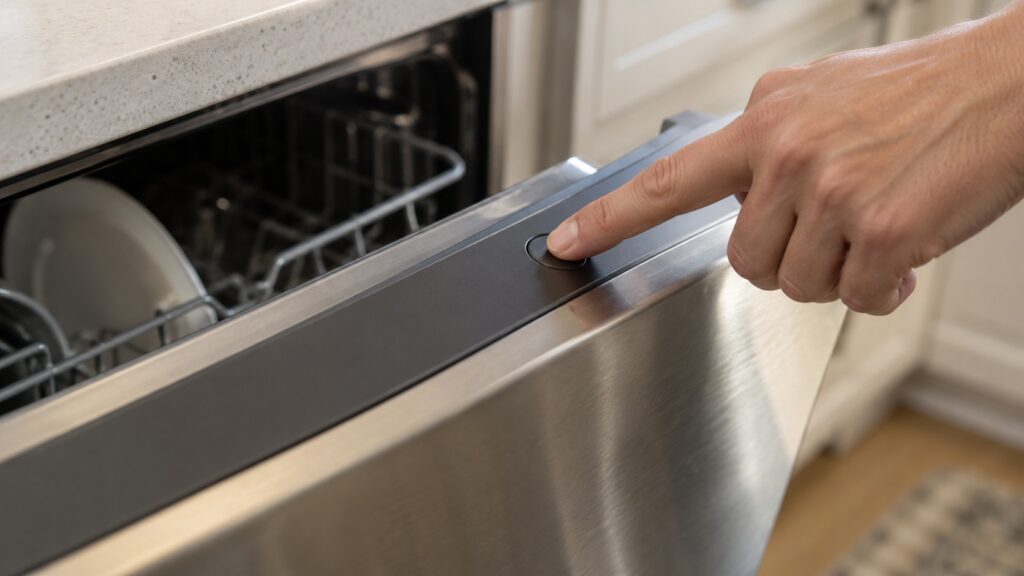
The method that works on every model is a power cycle. Stop the dishwasher, open the door a moment to confirm nothing is running, then switch off the circuit breaker that feeds it. Our code pages describe waiting for a minute to several minutes before restoring power, and the general LG advice on this site is to unplug for one to five minutes or trip the breaker for 30 to 60 seconds. Switch the breaker back on, close the door and start a new cycle. If the dishwasher is plugged into an outlet under the sink rather than hardwired, you can unplug it instead, but do not reach into a wet cabinet: if there is any water around the outlet, use the breaker and stand on a dry floor.
Do not expect a reset to change a setting such as the rinse aid level or a favorite cycle. If your model has a reset or cancel key combination, the owner’s manual shows it, and the exact steps differ by model.
What if the display shows PF or CL?
These two look like faults and are not. PF is a power-failure recovery prompt: it appears after the power cut out, and our page for it says to press start to resume the cycle or pick a fresh cycle. If PF keeps coming back with no real outage, check that the dishwasher is on its own correctly rated circuit and leave it for service if it still repeats. CL means the control lock is on, which can look like a dead panel. Find the key marked for control lock, press and hold it for about three seconds and the panel responds again; if you cannot find it, the page says to check your model guide for the exact key. Read more on the PF code and the CL code.
Does resetting fix drain, fill and overfill errors?
Only after you clear the cause. OE is a drain error, meaning the water is not draining. Check the drain hose for kinks, the high loop or air gap for clogs, and the disposer connection, then power-cycle the dishwasher at the breaker for a minute. IE is a water inlet error, meaning the dishwasher is not filling correctly, and FE is a fill or overfill error with too much water in the tub. A reset clears the code but not a kinked hose or a closed supply valve, so the code returns if the cause is still there. Our guides to an LG dishwasher OE code and a dishwasher that is not draining go through the checks.
What about motor, heater and temperature codes?
A power cycle is worth one try, and only one. LE is a wash motor error (some models show it as CE), NE is a diverter motor error, HE is a heater error where the dishwasher cannot heat or overheats and TE is a thermal or thermistor error. For LE, our page also says to check the sump and spray arms for debris or broken glass with the power off, and to confirm the arms spin freely by hand, before you retry. If a code returns after a reset, treat it as a real fault. Do not keep restarting a dishwasher that shows a heater or temperature code, and do not open the lower panel or the tub base to reach the part: that work is for a technician.
When should you not reset, and shut everything off instead?
When the code is AE, which means a leak was detected by the float in the base pan. Resetting it hides the warning while water may still be escaping, so do not keep running cycles. Turn off the water supply, switch the dishwasher off at the breaker and look for water under and behind it. Because a leak can damage cabinets and floors, book service rather than testing it again. The same applies if you smell burning, see smoke, or find water around the outlet or cord: switch off the breaker from a dry position and leave the door closed. Our page on an LG dishwasher leaking covers where leaks come from.
When is a reset not enough?
If the dishwasher shows the same code twice after a clean power cycle, if it will not start with no code, or if it ran fine until a recent power event and now behaves oddly, the cause is probably a part or the control. A technician can test the part instead of replacing things by guesswork. Our LG dishwasher repair page explains how a visit works, and you can write down the exact code before you power-cycle so the technician has it.