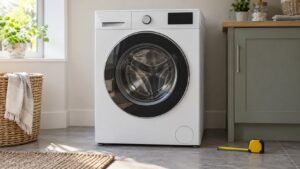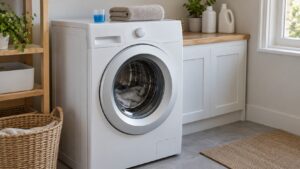
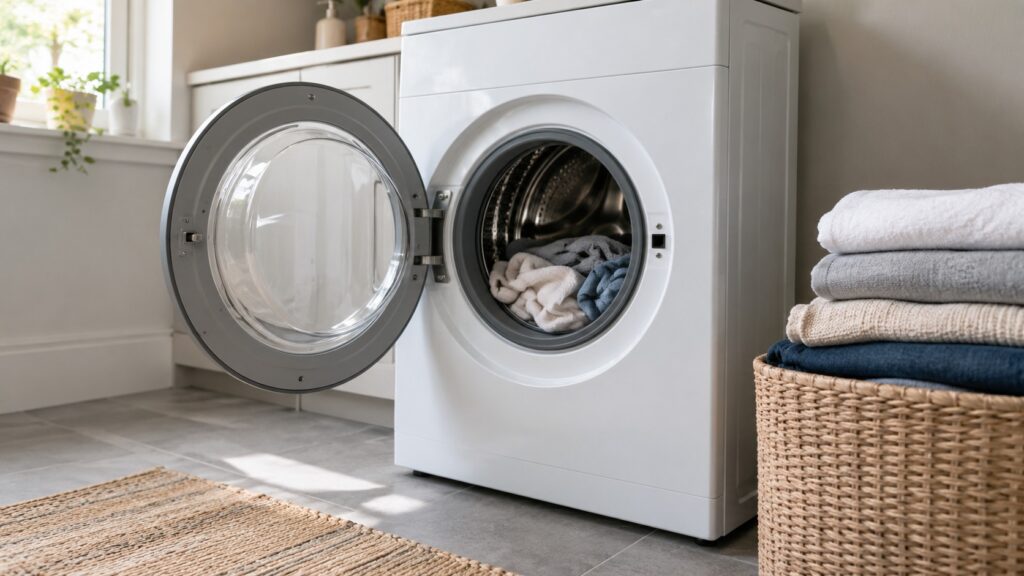
How LG washer load sensing works is only partly something an owner can see, so this guide sticks to what the washer visibly does with your laundry and what its display tells you. Before and during a cycle, an LG washer reads the water level with a pressure sensor connected to the tub by a small air hose, and before a high-speed spin it checks that the load is balanced, that the water has drained and that the door is locked. If any of those checks fails, the washer shows a code instead of spinning. How the machine estimates the weight of a load is set by the model, and this site does not describe it, so that part is left to your owner’s manual.
How does an LG washer know how much water to use?
Water level is the one measurement this site can describe in detail. According to our LG washer PE and FE code guide, a pressure sensor reads the water level through a small air hose connected to the tub. As water rises, the pressure in that hose changes, and the sensor reports it to the control. The washer uses that reading to know when to stop filling.
That is why a kinked or clogged sensor hose, a failing sensor or an inlet valve stuck open can all confuse the machine. The washer may think there is too little water or too much. PE is the water-level pressure-sensor error, FE means overfill, often from a stuck inlet valve, and IE is a related fill error. When any of those appears, the fix is about water measurement and not about the size of your laundry.
Does the washer weigh the load?
Our model pages list features such as 6Motion technology and AI DD on front-load models like the WM4000HBA and the WM6700HBA, and our Direct Drive guide says these build on the Direct Drive Inverter motor to vary wash actions by load. That is as far as the site goes. It does not explain how any model measures the weight of the laundry or which wash settings it changes in response, and we will not guess. The behavior can differ between models, so your owner’s manual is the right source for what your washer adjusts and when.
What you can observe is simpler. The washer is a belt-free machine: the Direct Drive Inverter motor attaches straight to the back of the drum, and the inverter control varies speed precisely. You do not need to adjust anything for that to work, but a motor that varies speed does depend on a drum that can turn freely and a load that is spread out.
What does the washer check before it spins?
A spin needs three things in order: the water must drain, the door must lock and the load must balance. Our LG washer won’t spin guide describes the codes for each:
- OE: the water did not drain, so the washer will not spin. See LG washer not draining.
- dE, dE1 and dE2: the door will not lock.
- UE: the load could not be balanced and the spin was abandoned.
- LE: the motor is locked or the drum will not rotate. This one can be the motor or a jammed item.
Each of these is a safety and protection step, not a defect. A washer that refuses to spin a badly balanced load is protecting itself and your floor.
What does rebalancing look like, and what is the difference between uE and UE?
Our LG washer UE unbalanced load guide makes an important distinction. Lowercase uE means the washer is actively rebalancing and is not a problem. Uppercase UE means rebalancing failed and the spin was abandoned. Both usually come down to how the laundry sits in the drum or whether the machine is level, and note the exact characters, because upper and lower case mean different things.
How can you help the washer read the load correctly?
You cannot change how the sensors work, but you can avoid the situations that confuse them. The site’s checks for a UE code are the best list:
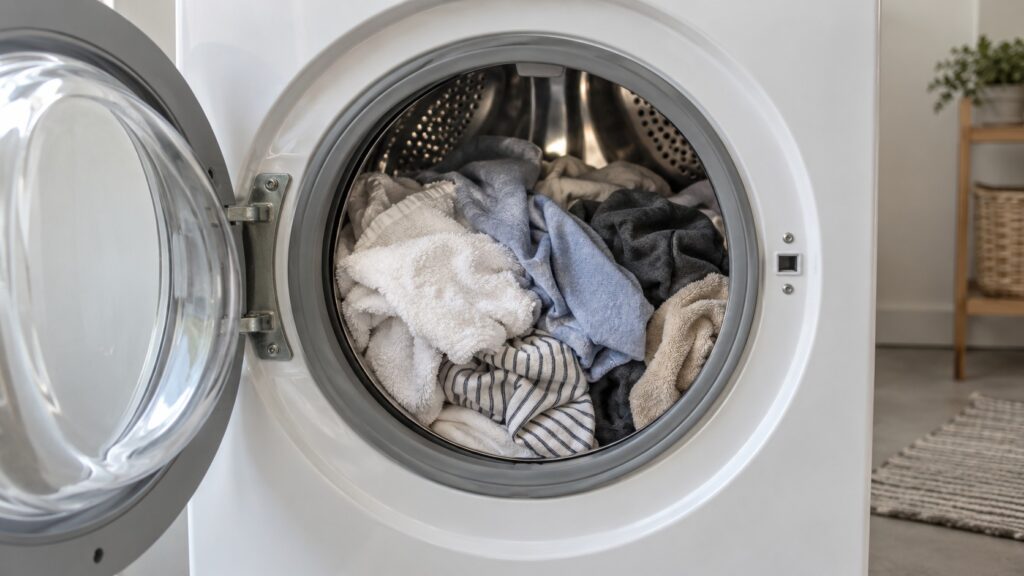
- Open the door and redistribute the laundry evenly around the drum.
- Do not wash a single bulky item such as one towel or one rug by itself; add a few items to balance it.
- Mix large and small items rather than washing only heavy pieces together.
- Check that the washer is level and the feet are locked, because a rocking washer cannot balance.
Level and shipping bolts matter for a new machine. On the WashTower, our installation guide says forgotten shipping bolts and an unlevel floor are the two most common causes of vibration and UE errors after install. Our site states the shipping-bolt rule for the WashTower only, so for a stand-alone washer check your installation instructions to see whether the model has shipping bolts or other transit hardware, and level it before the first load.
When does a load or water-level problem mean a failed part?
If the everyday checks do not help, the problem has likely moved from something you can adjust to a part that needs testing. Based on our code guides, signs include a UE code that keeps returning with a balanced, mixed load on a level machine, which can point to the suspension or a sensor, a drum that thumps hard against the cabinet during spin, a PE code that persists with a clear sensor hose, which suggests the pressure sensor itself, and an FE code that continues, which points to a stuck inlet valve. An LE code with a clear drum points toward the Hall sensor or the Direct Drive rotor and stator, and our LG washer LE code page covers it.
Do not open the cabinet or the drum area yourself. Testing a sensor, a valve or a motor part is a technician’s job. If water is reaching an outlet, a cord or the floor around electrical connections, switch off the breaker at the panel while standing on a dry floor, and never pull a plug from a wet outlet. Our LG washer repair page explains how a visit works.