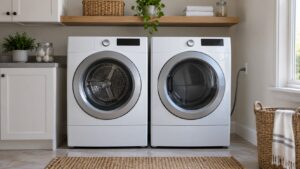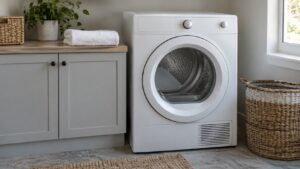
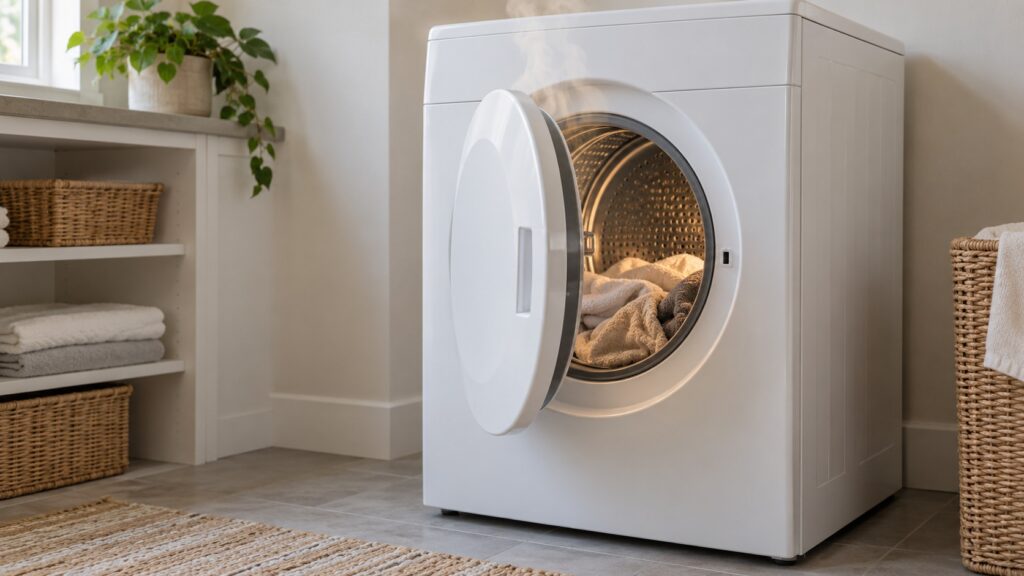
An LG dryer overheating is most often an airflow problem, not a broken heater. Lint in the filter or a blocked, crushed or too-long exhaust duct keeps hot air from leaving the drum, so the dryer runs hot and then protects itself: Flow Sense posts d75 to d95 as the duct restricts, d90 cools the cycle and may stop it, d95 stops it immediately, and a thermal fuse can blow and cut the heat entirely. If the cabinet is hot on the outside or you smell burning, stop the dryer and switch off its breaker at the panel while standing on a dry floor, then call for service.
Why is my LG dryer overheating?
The usual reason is that hot, moist air cannot get out. The lint filter catches only part of the lint; the rest builds up in the duct, choking airflow until the dryer overheats and protects itself, according to our LG dryer vent cleaning guide. The causes, in the order to look at them:
- A lint filter that is clogged or has a film of dryer-sheet residue on it.
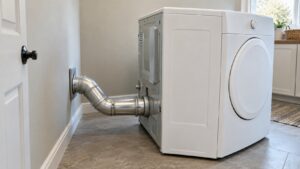
- An exhaust duct packed with lint, crushed behind the dryer or too long and bent.
- An exterior hood flap that does not open freely because of lint, a nest or snow.
- A flexible foil or plastic transition hose that traps lint and kinks.
- A long or convoluted duct run that shows high Flow Sense readings even when clean.
A thermal fuse that blew after a past vent blockage cuts heat entirely and needs replacement plus a vent cleaning, and a fuse is a protective part, so replacing it without clearing the vent just brings the problem back.
What do the Flow Sense codes tell you?
LG’s Flow Sense feature watches exhaust airflow and posts a number that approximates the percent blockage. Our LG dryer d90 and d95 code guide treats d80, d90 and d95 as duct-restriction warnings and not broken parts. A d75 or d80 is an early warning. A d90 is a call to clean the duct now. A d95 means the cycle stops at once to prevent overheating, so do not keep restarting the dryer. Long or twisted runs can show high numbers even when clean, and then the run itself may need to be redesigned by an installer.
The Flow Sense duct monitor is listed on the stand-alone dryer models on this site, including the DLEX4000B and DLGX4001B. If your dryer shows a d code, the duct is the first place to look, before any part.
Can a thermistor code come from overheating?
Yes. Our LG dryer tE codes page says tE1 is the inlet thermistor, tE3 is the outlet thermistor, tE2 is a cold-weather reading that often clears and tE4 is a temperature out of range. Our tE page notes that a blocked vent can push a good sensor out of range, and that tE4 shows up when airflow is restricted, among other causes. Before a sensor is bought, the vent run deserves a look.
What can you safely check yourself?
Keep to the owner-level steps this site lists:
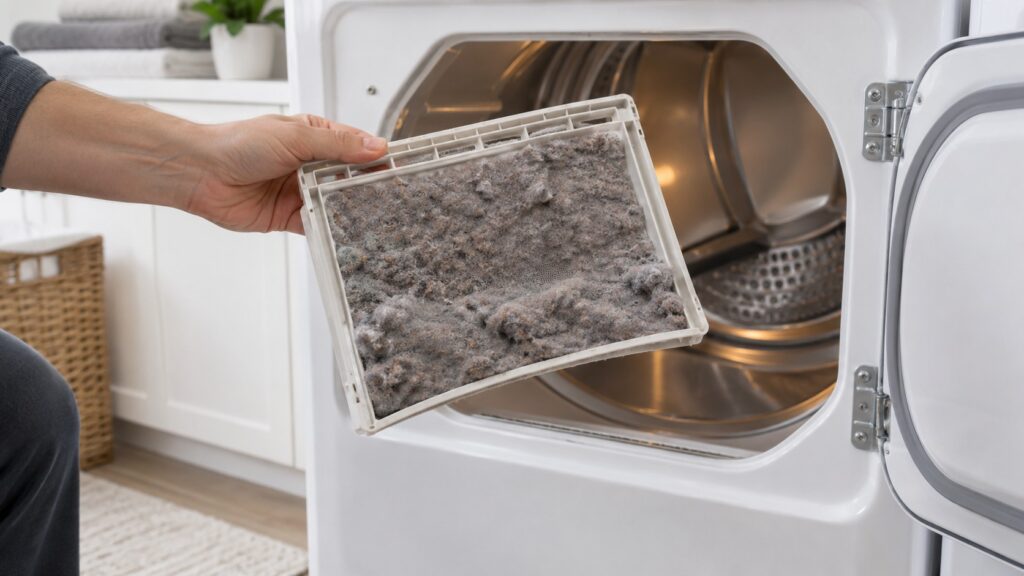
- Clean the lint filter at the start of every load, and wash it occasionally to remove dryer-sheet film. An F0 code means the filter is out or not seated.
- Walk outside while the dryer runs and see whether the exterior flap opens and is clear of lint, nests and snow.
- Look at the transition hose behind the dryer for crushing or kinks, and replace flexible foil or plastic with rigid or semi-rigid metal with as few bends as possible.
- If your dryer has the moisture sensor bars inside the drum, wipe off softener residue, as our slow-drying guide describes.
Cleaning the full duct from the dryer to the exterior is recommended at least yearly. If your dryer is a gas model, do not pull it away from the wall to reach the duct, because moving it can strain the gas connector. Leave duct cleaning on a gas dryer to a professional. Never run the dryer with the lint filter out.
What is different from a dryer that does not heat?
These are opposite symptoms with overlapping causes. A dryer that runs too hot or stops early points to airflow first. A dryer that tumbles but stays cold points to a missing 240-volt leg (nP), a half-tripped breaker, a failed element or igniter, or a blown thermal fuse. Our LG dryer not heating guide covers that side, and LG dryer takes too long covers the slow-drying version of the same airflow problem.
When should you stop and call a technician?
Stop using the dryer and call if the outside of the cabinet is hot, if you smell burning or scorching, if the dryer trips a breaker, if a d90 or d95 code returns after the vent has been cleaned, or if a tE code returns with a clear vent. For a burning smell or a tripping breaker, switch off the dryer’s breaker at the panel while standing on a dry floor. Do not open the dryer’s panels; that is a technician’s job, because the cabinet holds a heater, a blower and, on gas machines, a burner and a gas line. If you see smoke or flames, keep the dryer door closed, leave the house and call 911 from outside. If you smell gas, do not switch anything on or off and do not light anything; leave the house and call your gas utility or 911 from outside. Our LG dryer repair page explains how a visit works.