LG wine cooler maintenance is a short list done on a schedule, and it is the difference between a cabinet that holds its temperature for a decade and one that starts drifting in year three. Unlike a refrigerator, a wine cabinet is judged on steadiness rather than on cold, and almost everything that makes it unsteady — a dusty condenser, a tired gasket, a blocked drain — is something an owner can see and deal with. Here is the routine, in the order that matters.
The condenser is the job that pays
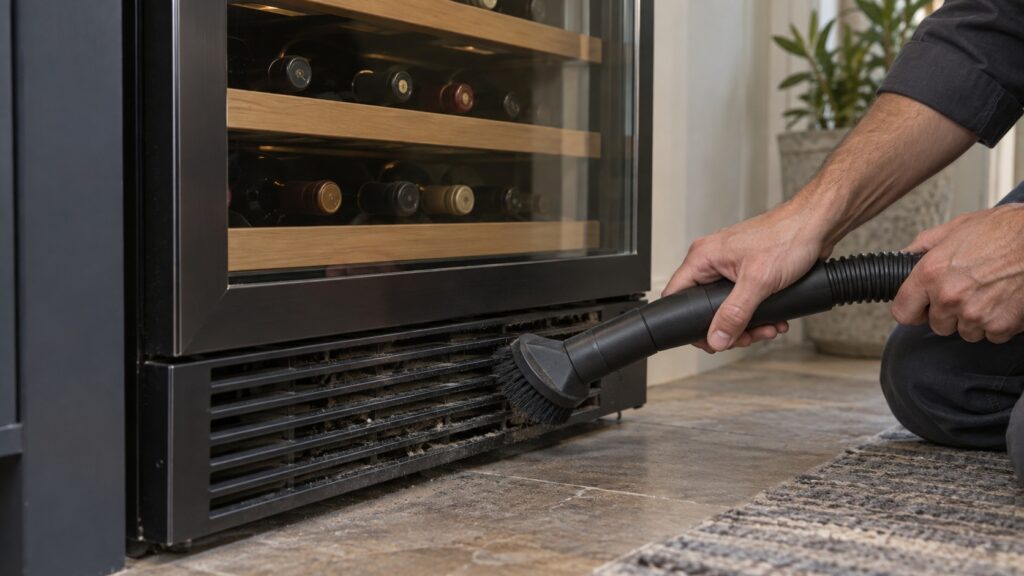
A wine cabinet rejects heat through a condenser, and a condenser blanketed in dust cannot do it. The compressor then runs longer and longer for the same result, which shows first as a cabinet that struggles on hot days and eventually as one that never quite reaches its setpoint.
Unplug the unit, find the vent grille — on a built-in cabinet it is at the bottom or the top of the door frame — and vacuum it with a brush attachment. Where the coil is accessible behind the grille, brush it gently in the direction of the fins. Nothing about this job is delicate except the fins themselves, which bend if you are rough with them.
Give the grille room to breathe afterwards. A basket of corks, a stack of napkins or a neighboring appliance pressed against the vent undoes the work immediately.
Door and gasket
Run a finger along the gasket every month. It should be supple, clean and continuous, with no folded sections and no crust of spilled wine at the bottom corners. Wipe it with warm water and a soft cloth — detergent and solvent harden the rubber and shorten its life.
A gasket that has flattened in one place lets warm, humid air into a cold cabinet, and the result is the condensation complaint owners usually blame on the glass. If you see moisture on the inside of the door or beads on the shelves, our page on condensation in a wine cooler covers what to check before assuming a refrigeration fault.
Level, still and unbothered
A cabinet out of level does two things: it stresses the door so the gasket cannot seal evenly, and it lets the compressor mount buzz against something it should not touch. Put a level on a middle shelf twice a year, adjust the feet, and check that no shelf rattles when the compressor starts.
Keep the cabinet out of direct sunlight and away from a heat source, and do not let racks be loaded so tightly that air cannot move around the bottles. Airflow inside the cabinet is part of the maintenance picture, not just a storage preference — our guide on wine cooler temperature covers the loading side of it.
Water, frost and the drain
The drain channel is usually a small trough at the back of the interior floor. Clear it with a cotton swab and a little warm water — never with a wire, which perforates the liner and turns a five-minute chore into a new cabinet.
Cleaning the inside without ruining the wine
Wine cabinets hold their smells. Clean the interior with warm water and a little baking soda, wipe everything dry, and leave the door open for an hour before reloading. Avoid anything scented — bleach, pine cleaners, citrus sprays — because that smell will be in the cabinet for weeks and corks are not a barrier to it.
Wooden shelves come out for cleaning and should go back dry. Wipe them rather than soaking them, and leave them to air fully; damp wood in a cold, closed cabinet is where mustiness begins.
The interior light is worth a mention while the cabinet is empty. Leaving it switched on continuously adds heat and light to a space designed to have neither, so use it when you are choosing a bottle and let it go off afterwards. If a light has failed, replace it rather than living without it — people prop doors open longer when they cannot see, and that costs more temperature than the lamp ever did.
Reading what the cabinet tells you
Note two things each month: whether the display matches a thermometer left on a middle shelf overnight, and how long the compressor seems to run. Those two numbers catch a drift months before the wine does. A cabinet that used to cycle quietly and now runs almost constantly is asking for the condenser job above — and if it has already had it, our guide on a wine cooler that is not cooling sets out the next steps.
When to call
Call when temperature drifts after the condenser has been cleaned and the door checked, when frost returns after defrosting, when water collects anywhere it should not, when the cabinet has become noticeably louder, or when a zone will not hold on a multi-temperature unit. Sealed-system work needs refrigerant handling and is not owner territory.
We are an independent repair company, not a factory service arm. Pricing starts from a diagnostic visit — from $89 — with the estimate confirmed before work begins. LG wine cooler repair covers compressors, fans, sensors, controls, lighting and door hardware, and you can schedule a visit online.