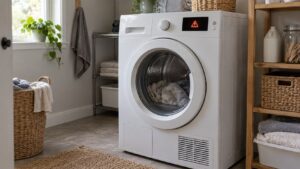
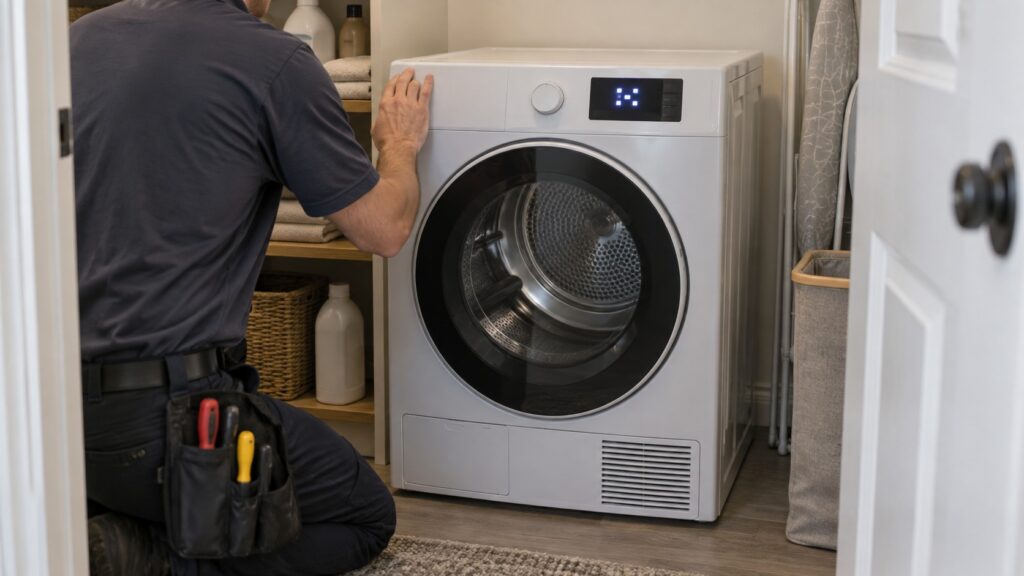
An LG heat pump dryer LE code names a motor or compressor failure in the heat pump system, and it appears only on ventless machines such as the DLHC1455W and DLHC5502W. LE1 is the drum motor, LE2 the compressor, LE3 the blower or fan motor, and the related CE1 is the compressor circuit. None of the four exists on a vented dryer, because a vented dryer has no compressor at all. If you want the mechanism behind this hardware, our guide to how LG heat pump dryers work explains it; this page is about what the machine does when one of those parts stops.
Why do these codes exist only on a ventless machine?
A ventless dryer has three motors where a vented one has roughly two: the drum, the blower, and a compressor that drives the closed loop of heat. That extra hardware needs its own fault reporting, and LG gave it a code group that a vented owner will never see. It also means a technician reads an LE code as a report about the machine’s most expensive subsystem, which changes how carefully the diagnosis is done before any part is ordered.
There is a practical consequence for owners comparing machines. The trade-off between the two designs — running cost, cycle time, installation freedom, and what fails — is set out in our comparison of a vented and a heat pump dryer. The codes on this page are one column of that trade-off, and they are worth reading before a purchase, not only after a fault.
What separates LE2 from CE1?
LE2 says the compressor is not doing its job. CE1 says the circuit that runs the compressor is at fault. In practice, the second is the better news: a relay, a capacitor, an inverter board or a harness are all serviceable parts, while a compressor is the heart of a sealed system and its replacement is the single most expensive repair this appliance can need.
The distinction is also why a technician does not accept LE2 at face value. Supply voltage, the starting circuit, the temperature sensors and the airflow all get checked, because a compressor that is prevented from running correctly reports very much like one that has failed. Condemning a sealed system on the first reading is how owners end up replacing a dryer that needed a relay.
What does LE3 usually turn out to be?
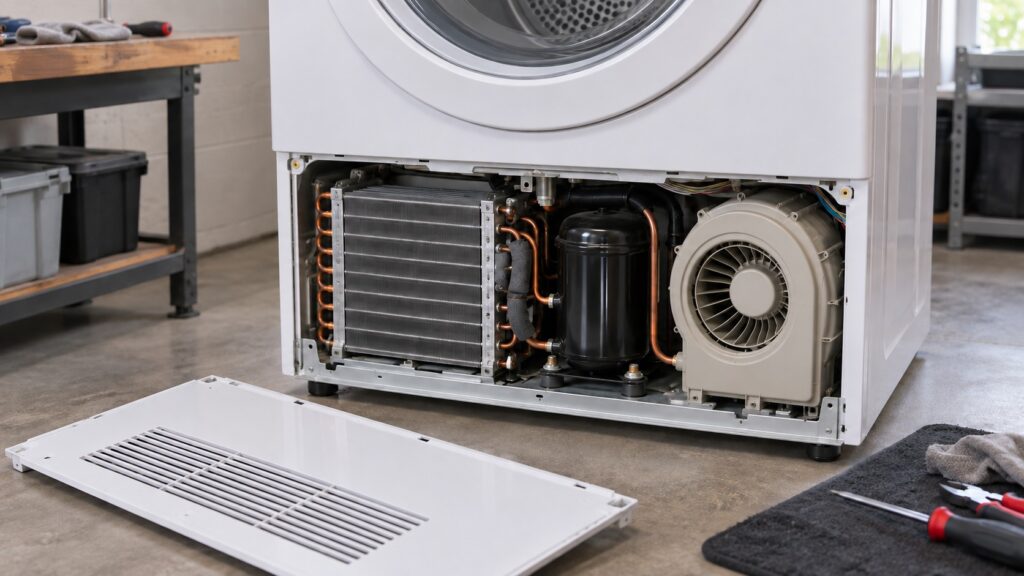
Air is everything in a ventless dryer. Instead of throwing warm damp air outside, the machine circulates it through an evaporator that condenses the moisture out and a condenser that warms the air again. The blower keeps that loop moving, and when it stalls the machine reports LE3.
Before the motor is blamed, the air path deserves a look, because a blower struggling against a blocked path fails in exactly this way. Clean the lint filters in the door — both layers, if the model has two — and check the secondary filter or the evaporator screen behind the lower access panel, which is the part owners most often do not know exists. A machine that has been drying slowly for months before the code appeared is telling you that the restriction came first; our page on a dryer that takes too long covers that phase of the story.
Is LE1 serious?
LE1 is a drum motor report, and it covers a range from trivial to major. At the trivial end: something jammed between the drum and the bulkhead, an item wrapped around the drum support, or a load so heavy that the motor cannot start it. Unplug the machine and turn the drum by hand — it should move smoothly, with no grinding and no catch.
At the other end are the motor and its drive circuit. On a ventless machine the drum motor also shares control hardware with the rest of the system, so a code that arrives together with LE3 or CE1 points at shared electronics rather than at three separate failures on one day. Always report the full set of codes you have seen, in the order they appeared.
What can an owner do, and where should they stop?
That last row is the honest boundary of this guide. Everything above it costs nothing and fixes a real share of LE codes; everything below it involves a sealed system under pressure and electronics that drive it.
Cycle timing is the cheapest diagnostic you own. A heat pump dryer runs longer than a vented one by design, so a cycle that has stretched from ninety minutes to three hours is not simply slow — it is a machine that has lost either air or heat, and the code that follows a month later is the end of that story rather than the start. Keep a rough note of how long a normal load takes now, and you will know within a week when something has changed.
When should you call?
Call when an LE or CE1 code returns after the filters are clean and the tank is empty, when the drum will not turn freely by hand, when the machine runs a full cycle without warming, or when the breaker trips. Note the model number and the exact codes before you call: LE2 and CE1 lead to different parts and different prices, and the difference is worth stating on the phone.
We are an independent repair company, not a factory service arm. Pricing starts from a diagnostic visit — from $89 — with the estimate confirmed before work begins; the number is 1-844-612-0846. LG dryer repair covers heat pump dryers as well as vented machines, and you can schedule a visit online.