An LG microwave F13 code reports an inverter over-current or voltage problem — the power supply that drives the magnetron is drawing or seeing something outside its limits and has shut itself down. It belongs to a small group of inverter codes that also includes F11 and F19, and it is worth separating them from the keypad and sensor codes in the same F series, because the inverter group is the one that is never an owner repair.
What is the inverter, and why does it get its own codes?
A conventional microwave feeds its magnetron through a heavy transformer that is either on or off; power levels are made by switching it on and off in bursts. An inverter machine replaces that transformer with an electronic supply that can hold a genuinely lower power continuously, which is what makes a true simmer or a gentle defrost possible. That electronics package monitors itself, and when it protests it reports in its own code group rather than simply going quiet.
Because the inverter is a distinct assembly, its codes say very little about the magnetron, the door or the turntable. If you want the background on how the power supply is meant to behave, our NeoChef glossary entry covers the feature side; this guide stays with the faults.
What causes an LG microwave F13 code?
Three families of cause account for most of them. The first is the supply: a weak, shared or sagging circuit, a long extension cord, or a house circuit that dips when the air conditioner starts. Inverters are less tolerant of poor supply than transformers are, and an F13 that only appears in the evening or only when another large appliance runs is pointing at the wiring, not at the oven.
The second is the magnetron itself. A magnetron that is breaking down draws current in a way the inverter reads as a fault, and the inverter shuts down to protect itself. The third is the inverter board: components on it age, especially in an over-the-range installation that lives in rising heat from the range below.
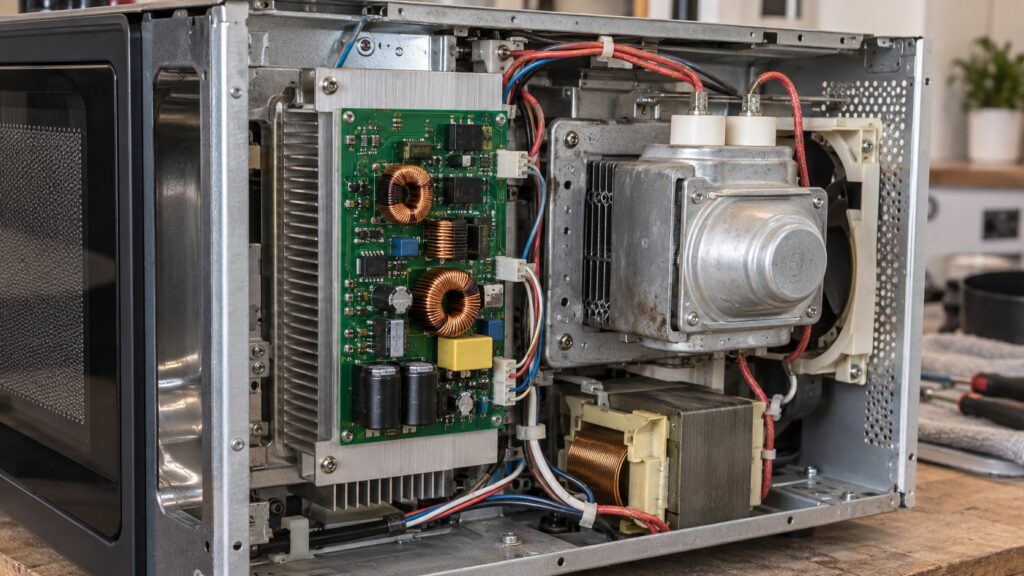
Timing narrows it further. A code that appears the moment you press start, before anything has had time to warm up, usually belongs to the supply or to the inverter itself. A code that waits until three or four minutes into a cook, and is more likely on high power than on a defrost setting, is behaving like a part that fails as it heats — a magnetron near the end of its life, or an inverter that has lost its cooling. Neither pattern is proof on its own, but both are free to observe and both change where a technician starts.
How is F13 different from F11 and F19?
F11 is a conversation that stopped. The main control sends instructions to the inverter and expects answers; when they stop arriving, the machine reports a communication problem. A loose ribbon or a connector shaken free during an installation can do it, and so can either board.
F19 brings heat and supply voltage into it. The inverter sits on a heatsink, and that heatsink is cooled by the same air path that cools the magnetron. An over-the-range unit with a blocked filter, or a countertop unit pushed back against a wall with its vents covered, will run its inverter hotter than the design allows. Before anyone prices a board for an F19, the air path gets checked.
What can an owner safely do?
Very little inside the cabinet, and that limit is not caution for its own sake. A microwave contains a high-voltage capacitor that can hold a dangerous charge after the oven is unplugged, and it does not care that the machine has been off for a week. Do not open the outer cabinet.
What you can do is worth doing first. Unplug the oven for five minutes and plug it back in; a genuine one-time fault often does not return. Plug it into a circuit of its own rather than sharing with a toaster or a coffee maker. On an over-the-range unit, clean the grease filters and confirm the vent is not blocked — the same airflow discussed in our guide to over-the-range microwave venting. Then note whether the code returns immediately, after a minute of cooking, or only on certain power levels, and tell the technician: that one observation shortens the diagnosis considerably.
One more free check belongs here. Put a cup of water in the oven, run it for one minute on full power and feel the cup. A machine that heats normally and then throws a code later is telling you the magnetron still works, which is worth knowing before any part is priced. A machine that throws the code with no heat at all points somewhere else entirely, and the fastest honest answer is that it needs a meter, not another cycle.
What does a technician check, and in what order?
That sequence separates a cheap outcome from an expensive one. A machine that will not heat at all may have a magnetron fault rather than an inverter fault, and our page on a microwave that will not heat is the better starting point when no code appears on the display.
Is it worth repairing?
An inverter assembly is one of the more expensive parts in a microwave, and on a countertop unit the repair can approach the price of a replacement. A built-in or over-the-range unit is a different calculation: the cabinet cutout, the vent work and the trim all favor repairing the machine you have. Our repair or replace guide for LG microwaves works through the arithmetic.
We are an independent repair company, not a factory service arm. Pricing starts from a diagnostic visit — from $89 — with the estimate confirmed before work begins; the number to call is 1-844-612-0846. LG microwave repair covers inverter assemblies, magnetrons, controls and door systems, and you can schedule a visit online.