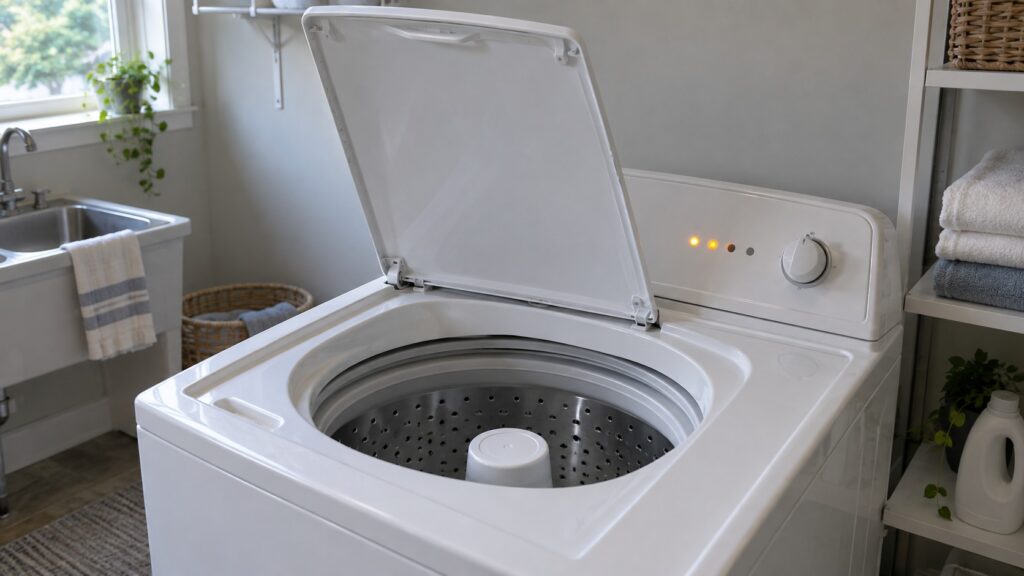
An LG washer CE code is an over-current or motor control error: the control measured more current through the drive than it will allow and stopped the cycle. On a top-load machine it has a close cousin, E6, which the site records as a clutch error. Both belong to the drive system rather than to water, drainage or the door, and reading them that way saves an owner from chasing a pump or a filter that was never involved.
What does an LG washer CE code mean?
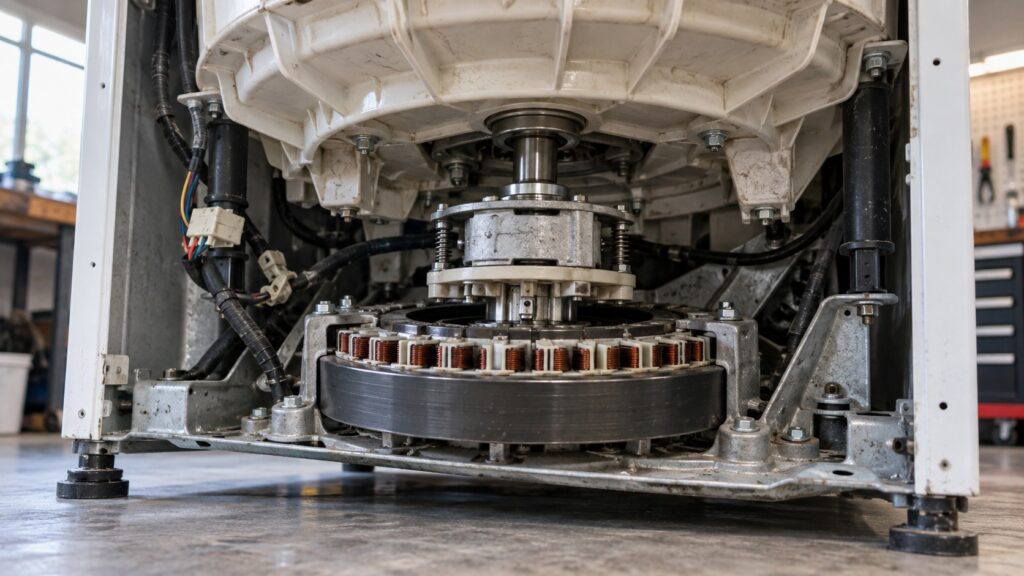
These machines use a direct drive motor bolted to the back of the tub, with no belt and no transmission in the usual sense. The control decides how fast the basket should turn, feeds the motor accordingly, and watches the current it is drawing. Current is a proxy for effort. When effort goes far beyond what the commanded speed should need, something is holding the basket back, or the motor circuit itself is faulty, and the control stops before anything burns.
That is why the same code can come from a very ordinary cause and from an expensive one. A jammed basket and a failing motor winding look similar from the control’s point of view, and the difference is found by hand rather than by display.
What is the clutch, and why does E6 name it?
A top-load LG washer has to do two different things with one motor: turn the pulsator or agitator back and forth during the wash, and spin the whole basket during extraction. The clutch is the mechanism that switches between those two jobs, coupling the motor to the basket for a spin and releasing it for agitation. It is a moving assembly under the tub, and it wears.
When the coupling slips, sticks or fails to engage, the machine asks for a spin and does not get the acceleration it expects. E6 records that mismatch. The symptom an owner notices is usually laundry left soaking wet at the end of a cycle, sometimes with a sound like a car pulling away in the wrong gear. Our guide to an LG washer that will not spin covers the same complaint from the symptom side when no code is shown.
Which ordinary causes come first?
Start with load and balance. A tightly packed drum, or a single heavy item such as a bath mat or a comforter thrown to one side, makes the basket hard to accelerate and hard to hold at speed. The machine will usually try to correct first and report an unbalanced load, which our page on the UE unbalanced load code explains, but a bad enough load can push the drive into an over-current stop instead.
Then check what is physically in the way. Unplug the machine, open it, and turn the basket by hand: it should move freely, with a little drag but no grinding and no hard stop. Coins, underwire and hair pins work their way between the basket and the outer tub and lock it just enough to matter. Items caught under the pulsator do the same thing on a top-load machine.
Supply matters too. A washer on a long extension cord, or on a circuit shared with a heavy load, can see enough voltage sag to be pushed into a motor control error. Plug it directly into its own grounded outlet.
What does a technician check, and in what order?
The order is the point. An over-current code that turns out to be a sock wedged under the pulsator costs a visit; the same code diagnosed by replacing boards costs several times that. If you want the background on why these machines have no belt at all, our explanation of how LG direct drive motors work fills in the mechanism.
One observation costs nothing and is worth writing down before the visit: at what point in the cycle does the code appear? A stop during agitation and a stop as the basket tries to reach spin speed send a technician to different parts of the same drive. Note the cycle, the load and whether the machine had drained by then, because a basket trying to accelerate through standing water behaves exactly like a mechanical drag.
Is a clutch worth fixing?
Usually yes, on a machine that is otherwise sound. A clutch and a rotor bolt are parts jobs, not a new appliance, and on WT-series top-load machines the assembly is designed to be serviced. The calculation changes when a worn clutch arrives together with failed bearings and a rusted basket, which is the point at which our repair or replace guide for LG washers earns its keep.
When should you stop and call?
Stop when the basket will not turn freely by hand, when the machine trips a breaker, when you smell hot windings, or when CE or E6 returns after the load, the supply and the obvious obstructions have been ruled out. Do not tip the machine onto its front or work under a tub that still holds water: drain it first, and remember the drum can hold gallons that do not show at the door.
We are an independent repair company, not a factory service arm. Pricing starts from a diagnostic visit — from $89 — with the estimate confirmed before work begins, and the number is 1-844-612-0846. LG washer repair covers clutches, rotors, stators, sensors and controls on WT top-load and WM front-load machines, and you can schedule a visit online.