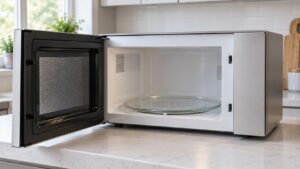
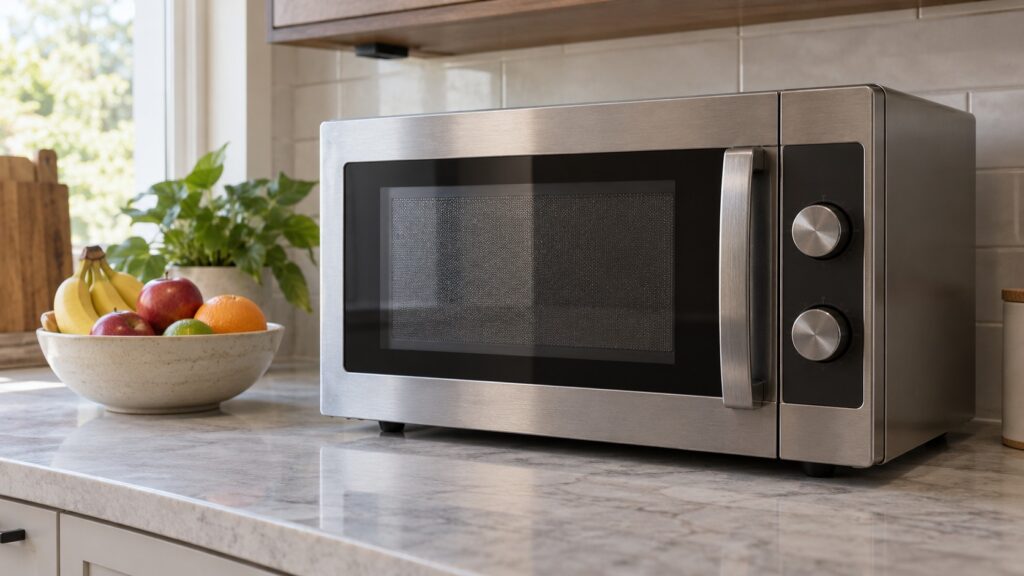
An LG Smart Inverter microwave is a microwave whose power supply can hold a steady lower power instead of switching full power on and off to imitate it. Every LG microwave model on this site, from the countertop LMC0975ST to the over-the-range LMV1764ST, lists “Smart Inverter even cooking” on its spec sheet, paired with Sensor Cooking. The practical result is gentler, more even heating at low power levels, such as defrosting or keeping food warm, and it also means the microwave has its own group of inverter fault codes. How the feature behaves on your exact model, including its power levels, is in the owner’s manual.
What is a Smart Inverter in an LG microwave?
Inside every microwave sits a magnetron, the part that generates the microwaves, and a power supply that feeds it. A conventional microwave uses a heavy transformer that is either fully on or fully off. To make “50 percent power” it pulses: full power for a while, then nothing, then full power again. The food experiences bursts of strong heating and rests between them. A Smart Inverter replaces that transformer with an electronic supply that can deliver a genuinely lower power continuously. The idea is simple and the benefit is practical: a softer, steadier input is kinder to delicate food.
This site’s own description of LG’s line says the same thing: a conventional microwave makes lower power by cycling the magnetron fully on and off, which can overcook edges, while Smart Inverter varies the power continuously so defrosting and gentle cooking are more even. Our LG NeoChef glossary entry covers the countertop line that carries the feature.
Where does it help in everyday cooking?
You notice it most at low and medium power. Defrosting is the classic example: a pulsing microwave can cook the outside of a chunk of meat while the middle is still frozen, whereas steady low power gives the heat time to spread. Melting butter or chocolate, softening cold items and reheating a plate of leftovers without rubbery edges all benefit in the same way. At full power the difference is small, because there is nothing to pulse. If you mostly boil a mug of water, an inverter will not change much; if you reheat delicate food or defrost often, it is the feature worth caring about.
It does not remove the need for common sense. Stir or turn food partway through, cover it loosely so steam can escape, and let it stand briefly so the heat evens out. Our LG microwave tips explain how Sensor Cooking reads steam, and why door-opening and covers change the result.
What is the difference between Smart Inverter and Sensor Cooking?
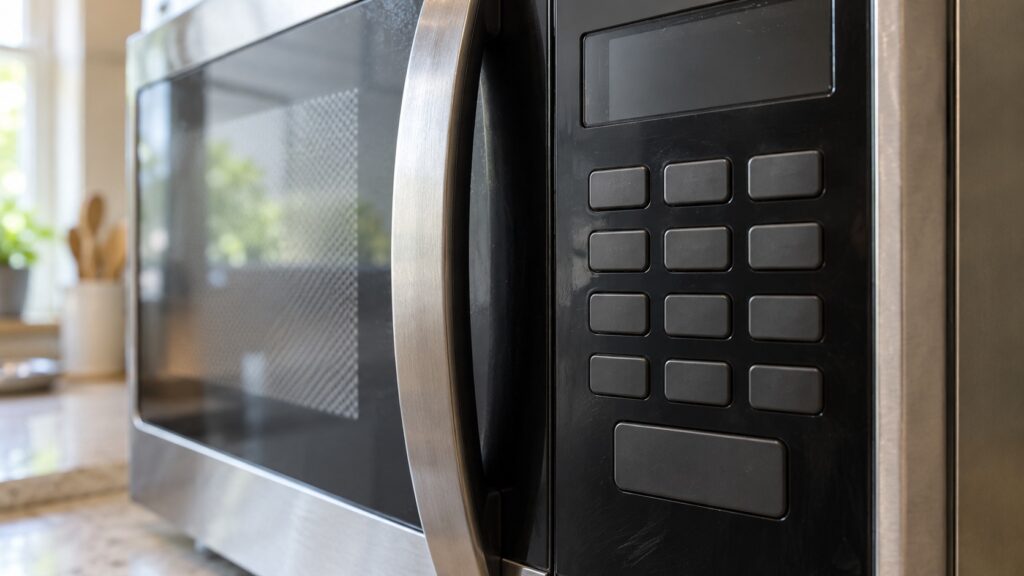
They solve different problems and work together. Smart Inverter controls how the power is delivered. Sensor Cooking decides how much power and time to use by watching the steam and humidity food gives off. One is the engine, the other is the driver. If a dish comes out wrong with an auto program, the cause is usually how the food was covered, placed or portioned, not the inverter. If the microwave refuses to run and shows an F code, the inverter side deserves attention. Do not mix the two when you read a spec sheet: a model can list both, as the LG models on this site do.
What goes wrong with an inverter microwave?
The inverter is an electronic assembly, and on an LG it reports its own faults. This site explains F11 as lost communication with the inverter, F13 as an inverter over-current or voltage problem and F19 as a heatsink or supply-voltage problem. Our guide to LG microwave inverter error codes goes through all three. The key point for owners: none of them is a do-it-yourself repair. A microwave holds a high-voltage capacitor that can keep a dangerous charge even when unplugged, so do not open the outer cabinet.
What you can do safely is limited and useful. Plug the microwave in as the installation section of your owner’s manual describes. On an over-the-range unit, clean the grease filters so the air path stays open, as our LG microwave filter cleaning guide describes. Notice when the code appears, right at the start or later in a cook, and tell the technician. If the microwave runs but does not heat, read LG microwave not heating, and if you ever see sparks inside, stop the microwave at once and read LG microwave sparking.
Is a Smart Inverter microwave worth repairing or replacing?
That depends on the unit and the fault, so use a decision rather than a rule. A simple fix, such as a filter or a door issue, is almost always worth doing. An inverter or magnetron repair on an older, inexpensive countertop unit may not be, while the same repair on a built-in over-the-range model often is, because replacing it also means redoing the installation. Our repair or replace LG microwave guide sets out how to weigh it, and the LG microwave repair page explains what a visit involves.