The LG ice maker repair or replace question is rarely about the ice maker alone. LG does not sell a standalone ice maker in the US; the ice maker lives inside the refrigerator, so the decision is between fixing the ice-making parts, replacing an ice maker module or kit where your refrigerator allows it, and replacing the whole refrigerator. Water supply, filter, freezer temperature and the ice maker’s own parts are routine, worthwhile fixes. Replacement only comes into the picture when the refrigerator itself has a bigger problem or the ice maker keeps failing after a proper diagnosis.
What does repair or replace mean for an LG ice maker?
Because the ice maker is part of the refrigerator, our LG ice maker not working guide points out that the on/off setting, the water supply, the filter and the freezer temperature all matter, and any codes appear on the refrigerator display. That changes the question. You are not deciding whether to throw away a small appliance; you are deciding how much trouble the ice-making system has and how that compares with the health of the refrigerator around it.
Our repair or replace LG refrigerator guide gives the general rule: fans, sensors, icemakers and defrost parts are routine, worthwhile repairs, while a sealed-system or Linear Inverter compressor failure is the classic replacement trigger on an older unit. An ice maker problem alone sits on the repair side of that line.
Which ice maker problems are worth repairing?
Start with the simple causes, because they cost the least to fix and fix the most complaints. From this site’s guides:
- The ice maker is switched off, which is easy to do by leaving the toggle or feeler arm off after cleaning.
- The water line is kinked, frozen or the shutoff valve is closed.
- The water filter is overdue. The guide says a genuine LG filter is changed about every six months, and a clogged filter starves the ice maker.
- The freezer is not cold enough. The guide says the freezer should ideally be near -4°F and at least around 19°F for harvesting.
- A thin wall of ice across the fill tube, a sign of slow water flow refreezing, which our LG ice maker leaking guide covers along with level and the water line connection.
If those checks do not help, the next suspects are an inlet valve that buzzes without delivering water, the fill tube, a cracked mold or tray and the ice maker fan. These are repairs for a technician, not owner projects. They are routine work on the repair side of the decision.
What do the ice maker codes tell you?
LG refrigerators report ice maker trouble on the refrigerator display. Per our code pages, IF is the ice-maker fan, gF is the water flow sensor or low water pressure, and It is an ice-maker assembly defect that needs service. A gF code points you at water pressure, the line and the filter first, so it favors a simple repair. An It code means the assembly itself needs attention, which is where the question of replacing the module comes up. Write down the exact code before you call; it helps the technician.
When does replacing the ice maker module or kit make sense?
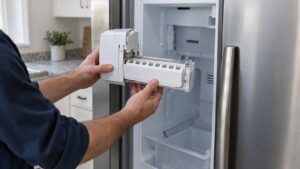
Our model pages list four ice maker kits: the LK50C and LK75C for select LG top-freezer refrigerators, the LK60C and the LK65C for ice-maker-ready refrigerators, with the LK65C described as a universal kit for many ice-maker-ready LG refrigerators and freezers. Each is described as a genuine LG factory component that installs inside a compatible refrigerator or freezer and connects to the refrigerator water line. They are not standalone appliances.
Two things follow. First, a kit only helps if your refrigerator is one it is made for, and the site does not list which refrigerators match each kit, so a technician or your model’s documentation has to confirm compatibility. Second, replacing the module only makes sense once the diagnosis shows the module is the failed part. Water supply, filter and freezer temperature problems will not be fixed by a new module.
Craft Ice is a special case. Our LG Craft Ice not working guide says it is slow by design, with only a few rounds a day, so low output can be normal. Check that Craft Ice is enabled before you treat slow output as a failure. If you are curious how it works, see how LG Craft Ice works.
When should you replace the refrigerator instead?
Weigh replacement when the ice maker is only one sign of a larger problem. Our refrigerator guide names a sealed-system or Linear Inverter compressor failure on an older unit, a CL E refrigerant leak on an older out-of-warranty unit and repeated problems across several systems on an aging refrigerator as the replace-leaning signals. If your refrigerator is also warm, noisy or showing other codes, an ice maker repair may not be the best use of money. A confident diagnosis before you decide is worth more than guessing from one symptom. If you are leaning toward a new refrigerator, our LG Craft Ice maker buying guide explains one feature to look for.
What should you do before you call?
Do the safe checks only: confirm the ice maker is on, the shutoff valve is open and the water line is not kinked, replace an overdue filter, check the freezer temperature and level the refrigerator if water pools. Do not remove panels, the mold or any part of the ice maker assembly; that is a technician’s job. If water is leaking toward an outlet or the floor near electrical parts, switch off the breaker at the panel while standing on a dry floor and do not pull a plug from a wet outlet. Our LG ice maker repair page explains how a visit works, and you can also read our LG ice maker maintenance guide for routine care.