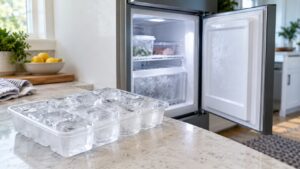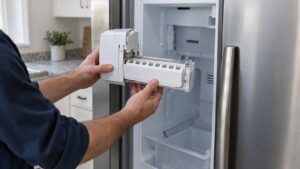
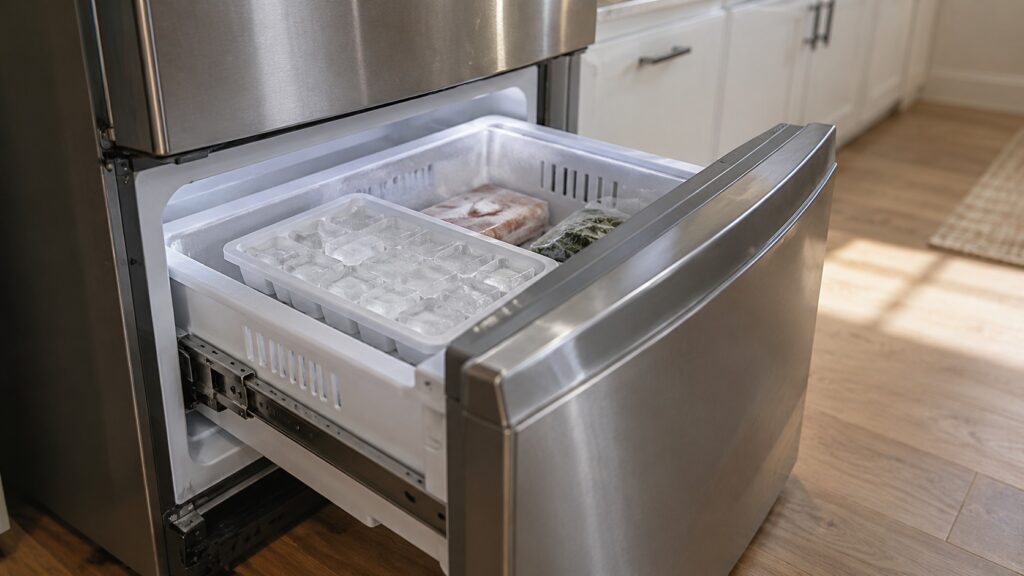
People who search for how LG refrigerator ice maker works usually want the short answer, and it is a repeating loop: water is let into a mold, the freezer air hardens it into ice, the ice is released into a bin, and the machine waits for the bin to need more. It is part of the refrigerator itself, because LG does not sell a standalone ice maker in the US, so everything it needs comes from the refrigerator: a water line, a cold freezer and a clear path for the ice to fall. Knowing that loop is the quickest way to tell which part of it has failed when ice stops.
What does an LG refrigerator ice maker need to run?
Three things, and they are the same three things behind most ice problems. The first is water that actually reaches the mold: the supply line must be connected and open, the filter must not be clogged, and the inlet valve must open. The second is a freezer cold enough to freeze the water and keep the finished ice hard. Our ice maker troubleshooting page gives the target as ideally near -4°F and at least around 19°F, and treats a freezer above that as a reason for ice to stop. The third is a clear way out for the ice: a bin seated properly, a door that closes and a mold that is not locked solid in frost. Remove any one of the three and the loop stops at a different step, which is why the symptom tells you where to look.
How does the water reach the mold?
Water enters the refrigerator from the house supply line, passes through the water filter and then through the inlet valve, which opens when the ice maker asks for water. From there a fill tube carries a measured amount to the mold. The valve and the tube are the two weak points: a valve that buzzes without passing water, or a fill tube with a thin wall of ice across it, means water is arriving too slowly or not at all. An overdue filter is one of the usual restrictions, and our troubleshooting guide treats a filter change at about every six months as the baseline. If you are planning the supply for a new installation, read our notes on the LG refrigerator water line setup.
How does the ice freeze and get released?
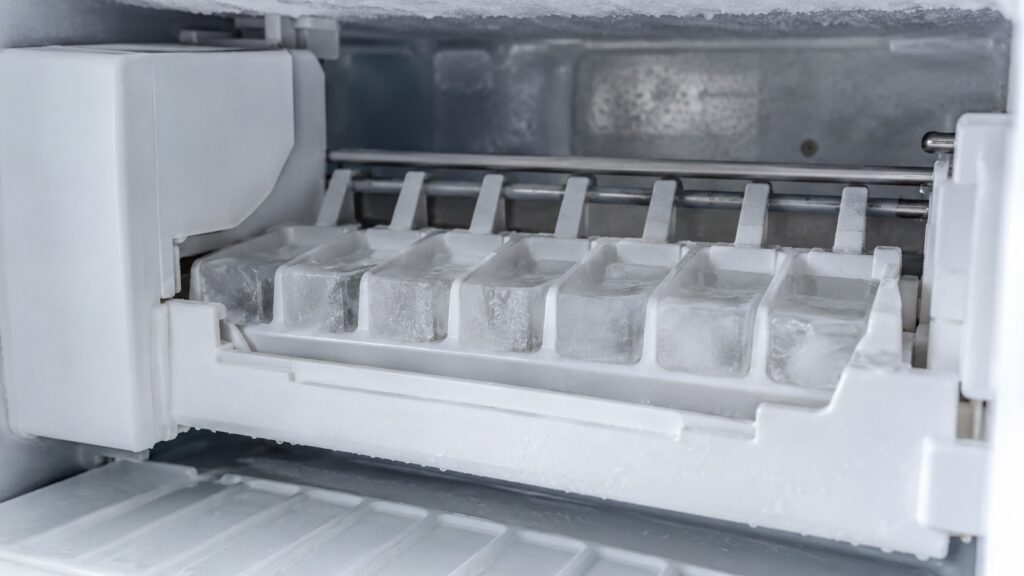
Once the mold is filled, cold air from the freezer does the work. The mold sits in the airflow, and the water in it turns into ice over the following period. How long that takes depends on the freezer temperature, how often the door is opened and the design of your model, and this site does not publish a time, so use your owner’s manual if you need one. When the ice is ready, the maker releases it from the mold into the bin. Most refrigerator ice makers do this with a small motor or a short warming of the mold, but LG does not describe the release method for each model on this site, so we cannot say which yours uses.
How does the maker know when to stop?
An ice maker does not keep making ice into a full bin: it pauses when the bin is full and carries on when ice is taken out. How your model detects that differs, and this site does not describe the method, so check your owner’s manual. What the site does say is that the ice maker has an on/off setting, a feeler arm or a toggle depending on the model, and that it is easy to leave it switched off after cleaning. Our troubleshooting page lists that as one of the first things to check. If the ice maker has stopped and the bin is not full, look at that arm or switch before you suspect a part.
What are the other ice systems LG uses?
LG makes two named variants that change where the ice maker is or what shape it makes, and both follow the same loop. SpacePlus Ice puts the ice maker in the refrigerator door instead of the freezer, with water routed through the hinge and cold air ducted across. Craft Ice uses a dedicated mold in the lower freezer to make round, slow-melting spheres, and the site notes that it produces only a few rounds a day, so low volume is normal there. Some models, such as the LRYXC2606S and URNTC2306N, list a dual ice maker with Craft Ice. Knowing which kind you own tells you where to look when ice slows.
Which failures point to which step?
Match the symptom to the step. No ice at all with a cold freezer points to the water path: the filter, the inlet valve or a frozen fill tube. Small or hollow ice points to slow water flow. Clumped ice or ice that is wet points to refreezing at the fill tube or a freezer that is too warm, and our page on an LG ice maker leaking covers that case. Ice that is made but will not come out of the dispenser is a dispensing problem, not a production problem. For the broad no-ice case, work through the LG refrigerator ice maker not working checks in order. Codes shown on the refrigerator display narrow it faster than anything else: IF or 1F points to the ice-maker fan, gF to the flow sensor or low water pressure, and It or iT to the ice-maker assembly. IS, 1S, EID and EIU are service-required codes with no home fix.
Stop and call for help if water is leaking onto the floor, if the freezer is warm and food is thawing or if a code returns after you unplug the refrigerator for a few minutes and plug it back in. Do not open the cabinet panels to reach the fill tube, valve or wiring: that is work for a technician. Our LG ice maker repair page explains the visit.