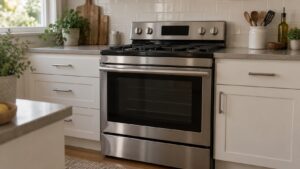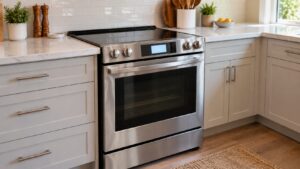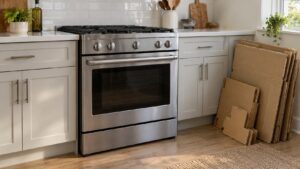
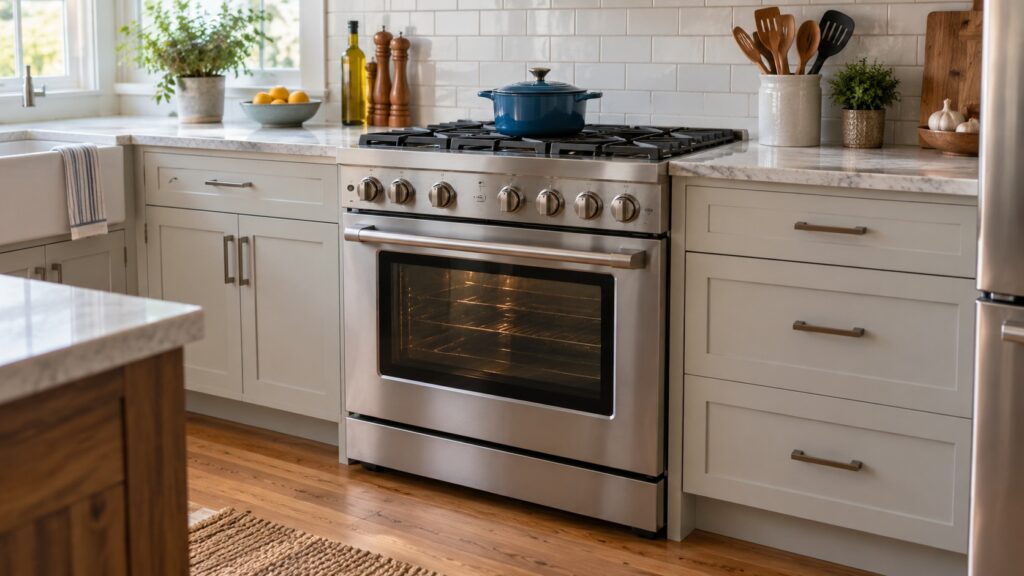
The LG range buying guide comes down to four choices, made in this order: fuel (gas, electric or dual fuel), shape (slide-in or freestanding), oven (one cavity or two) and oven features (ProBake or True Convection, Air Fry, InstaView). Fuel decides what has to be behind your wall, shape decides how the range sits in the opening, and the rest is cooking preference. The models listed on this site cover every combination, so you can match your kitchen to a real model number rather than a brochure.
Should you buy a gas, electric or dual-fuel LG range?
Start with what your kitchen already has, because changing fuel is a project rather than a delivery-day job. A gas range needs a gas supply at the wall; an electric range needs a dedicated circuit. Our LG range repair or replace guide puts it plainly: gas to electric means a new circuit, and electric to gas means a gas line, and neither is something to improvise on installation day.
Gas ranges such as the LSGL6335F and LRGL5823S use sealed gas burners, including an UltraHeat Power Burner for fast boiling. Electric ranges such as the LSEL6335FE, LSEL6337F and LREL6325F heat the cooktop with radiant elements, including a high-power element. The LSDL6336F combines the two, with a gas cooktop and an electric oven. If you are weighing gas against induction rather than gas against electric, read our gas vs induction cooktop guide first, because induction is a separate family from the radiant electric ranges described here.
Any gas connection, shutoff or gas-line change is a job for a licensed installer. If you ever smell gas, do not touch switches or flames: leave the house and call your gas utility or 911 from outside.
Slide-in or freestanding: which fits your opening?
The site lists both shapes. The LSGL6335F, LSEL6335FE, LSEL6337F, LSDL6336F and LTEL7337F are slide-in ranges; the LRGL5823S, LRGL5825F and LREL6325F are freestanding. The two are not interchangeable, and a swap can mean countertop or cabinet work, so measure the opening and compare it with the dimensions in your owner’s manual or the model’s spec sheet before you commit.
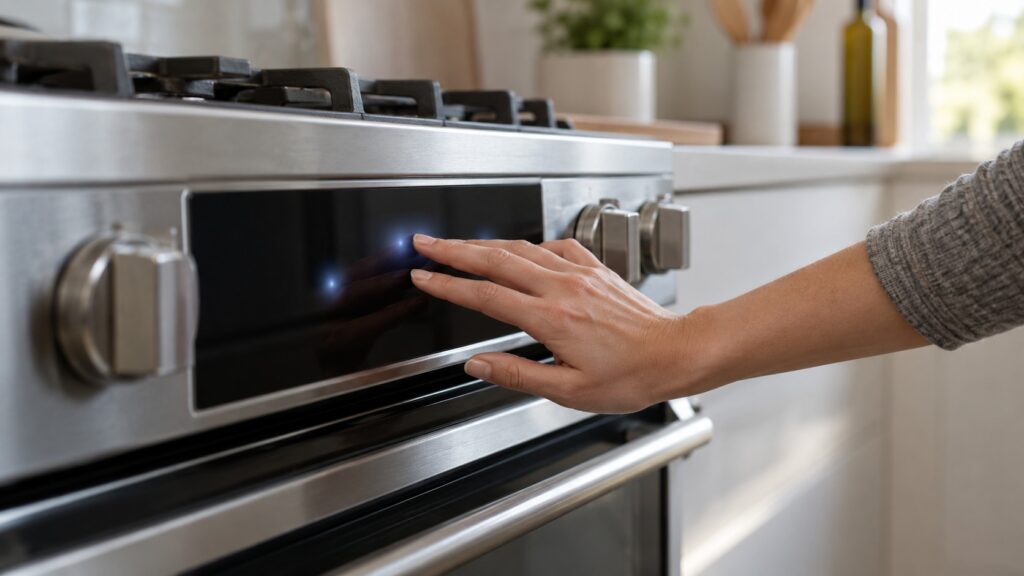
The oven window is part of the shape decision too. The slide-in models on this site carry an InstaView window, a glass panel that lights when you knock on it so you can look in without opening the door. The freestanding models carry a standard window. Opening the door dumps heat the elements have to replace, which is the only practical argument for the glass panel, and it does not change how the oven bakes.
What do ProBake Convection and True Convection mean on an LG range?
Both are listed on the model pages. According to our ProBake and EasyClean glossary, ProBake moves the heating element to the back, behind the fan, so heated air moves forward across every rack. True Convection adds a third element wrapped around the fan itself, so the air that reaches the food is already at temperature. The slide-in models on this site are ProBake models; the freestanding ones are True/Fan Convection models.
Air Fry is a convection mode, not a second appliance. The LSGL6335F, LSEL6335FE, LSEL6337F, LSDL6336F and LTEL7337F list Air Fry plus Air Sous Vide; the freestanding models list Air Fry on supporting models only. Because it borrows the convection system, there is nothing extra to fail beyond the fan and element you already own.
Do you need a double oven?
The LTEL7337F is the only double-oven electric range among these seven, and its 7.3 cu ft figure is the total across both cavities. A second cavity gives you two temperatures at once, and it also means a second set of oven parts to diagnose. On a double oven, many fault codes come in upper and lower pairs, which is why our LG range F-codes guide separates F1 from F4 and F10 from F20. If one cavity dies, report which one on the first call; it removes half the electrical system from the diagnosis.
What features should not decide the purchase?
Every model on the list shows EasyClean plus a self-clean cycle, ThinQ with Smart Diagnosis over Wi-Fi and a PrintProof Stainless finish. Treat those as the baseline rather than a reason to pay more. Per the glossary, EasyClean is a low-heat, water-based clean of about ten minutes that does not lock the door, while Self Clean is the high-heat cycle that locks the door until the cavity cools. PrintProof changes how you clean the outside and nothing else.
The Smart Oven Probe is listed on the models that support it; the freestanding gas and electric models list temperature management instead. Whether a feature is worth it depends on how you cook, and there is no technical reason to avoid one.
How reliable is it, and what will it cost to keep?
There is no wear-out part in an oven cavity or a burner the way there is in a compressor. The parts that fail on a range are consumable by design: igniters, elements, sensors, latches and fans. The repair guide notes that elements, igniters, sensors and switches stay available for years, which is what keeps an older range economically repairable. Buy for the features you will actually use. If you want to see what a visit covers, read about our LG range repair service.